Home / Applications / Titanium Aerospace Parts: Grades, Specifications and Documents
Titanium Aerospace Parts: Grades, Specifications and Documents
Titanium aerospace parts are mostly Ti-6Al-4V brackets, fittings, lugs, manifolds and fasteners bought to AMS specifications, with near alpha alloys in hot engine sections and beta alloys in heavy landing gear forgings; the machining is ordinary titanium work, and what sets the price is the specification, inspection and document chain around each part.
Key facts
| Item | Typical for aerospace titanium |
|---|---|
| Main alloy | Ti-6Al-4V (Grade 5), annealed or STA |
| Bar specification | AMS 4928 (annealed), AMS 4965 (STA) |
| Plate specification | AMS 4911 |
| Hot section alloys | Near alpha, such as Ti-6Al-2Sn-4Zr-2Mo |
| Landing gear alloys | Beta and near beta forgings, such as Ti-10V-2Fe-3Al, Ti-5Al-5Mo-5V-3Cr |
| First article | AS9102 report where the order calls it |
| Common NDT | Penetrant to ASTM E1417, ultrasonic of bar to AMS 2631 |
| Quality system asked for | AS9100, a question for the shop, not a claim of ours |
| Special processes | Heat treatment, NDT, chemical processing, anodize: often NADCAP accredited sources |
| Export control | Classify drawing and part before the RFQ circulates |
All entries are typical of what aerospace drawings call. The drawing, the purchase order and the customer’s flow down clauses govern each part.
Parts and the grade each one usually takes
| Part family | Usual alloy and condition | Usual stock specification | What drives the choice |
|---|---|---|---|
| Brackets, clips, angle fittings | Ti-6Al-4V annealed | AMS 4911 plate or AMS 4928 bar | Strength in a small envelope next to CFRP |
| Lugs, clevises, fork ends, links | Ti-6Al-4V annealed or STA | AMS 4928, AMS 4965 or forgings | Bearing and fatigue loads |
| Hydraulic manifolds and fittings | Ti-6Al-4V annealed | AMS 4928 bar | Pressure, weight, corrosion |
| Hydraulic tube | Ti-3Al-2.5V (Grade 9) | Aerospace tube specification on the drawing | Cold formed, high pressure lines |
| Fasteners and pins | Ti-6Al-4V STA | Fastener material specification on the drawing | Strength, galvanic fit with CFRP |
| Engine mounts, pylon fittings | Ti-6Al-4V annealed or STA | AMS 4928, forgings | Temperature to roughly 400 °C |
| Compressor parts, hot structure | Near alpha alloys such as Ti-6242 | Alloy specific AMS documents | Creep resistance above Ti-6Al-4V’s range |
| Landing gear beams, heavy forgings | Ti-10V-2Fe-3Al, Ti-5553 | Forging specifications | Deep hardening in thick sections |
| Seat track and interior hardware | Ti-6Al-4V | AMS 4928 or AMS 4911 | Corrosion where aluminium fails |
| Space hardware, tanks and brackets | Ti-6Al-4V, ELI for some pressure parts | Customer specifications | Toughness and weight |
Typical patterns, not rules. The Grade 5 page covers the main alloy and the titanium families page the near alpha and beta alloys.
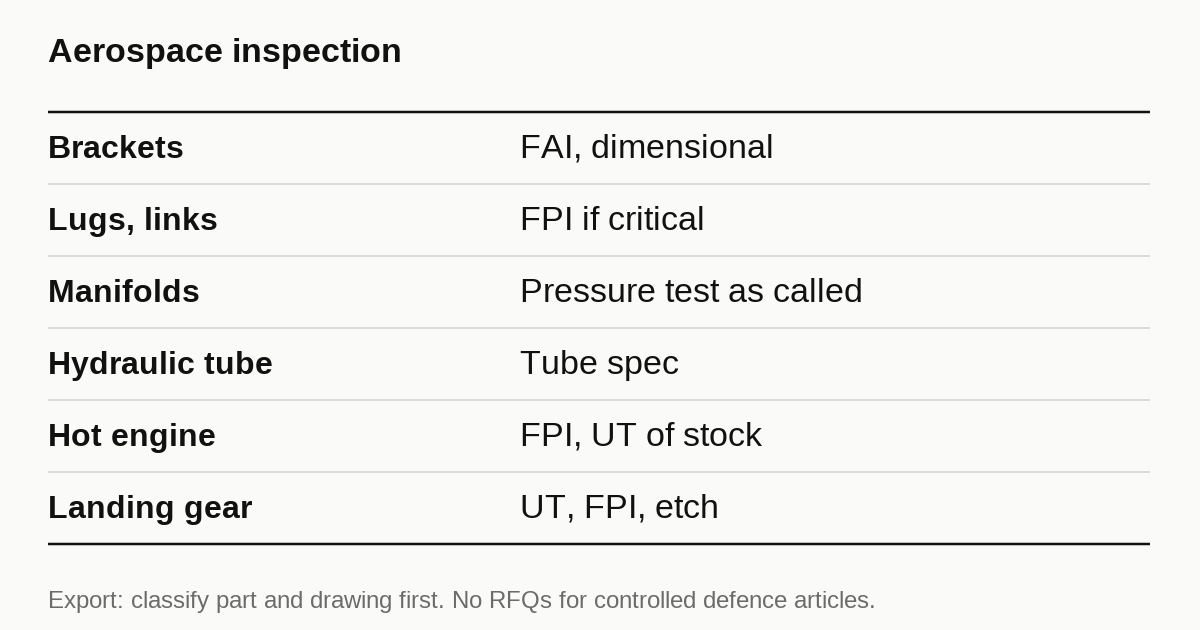
Why titanium is on the aircraft
Three properties decide most aerospace uses. Ti-6Al-4V keeps useful strength to roughly 400 °C, so it works in engine mounts, nacelles and bleed air hardware where aluminium has lost its strength. It sits close to carbon on the galvanic series, so it can be fastened to carbon fibre composite structure without the galvanic attack that aluminium suffers. And it carries steel like loads at about 60 percent of steel’s weight, which matters most in parts that cannot grow.
The trade is cost. Titanium bar costs several times aluminium per kilo, buy to fly ratios on machined fittings are often high and the cutting runs at a fraction of aluminium speeds. The buy to fly calculator shows how much of the bar ends up as chips.
Specifications that come with the part
Aerospace drawings name a material specification, a condition and often several process specifications. The grade name alone never carries enough information.
| Callout | What it fixes |
|---|---|
| AMS 4928 | Ti-6Al-4V annealed bar, wire, forgings, rings, drawn shapes |
| AMS 4911 | Ti-6Al-4V annealed sheet, strip, plate |
| AMS 4965 | Ti-6Al-4V solution heat treated and aged bar and forgings |
| AMS 2801 | Heat treatment of titanium alloy parts |
| AMS 2631 | Ultrasonic inspection of titanium bar, billet and plate |
| ASTM E1417 | Liquid penetrant testing practice |
| AMS 2488 | Anodic treatment of titanium (Type II is common on aerospace parts) |
| AS9102 | First article inspection requirement |
Check the current revision of each before it goes on a drawing or RFQ. The AMS 4928 page goes into the bar specification in detail.
Inspection and the reports buyers expect
| Check | When it is called | What the buyer receives |
|---|---|---|
| First article inspection, AS9102 | First production part, new revision, process change | Ballooned drawing and the AS9102 forms |
| Dimensional inspection | Every lot, to the sampling plan on the order | Inspection report, CMM data on critical features |
| Fluorescent penetrant | Fracture or fatigue critical parts | Report from the NDT source with method and sensitivity |
| Ultrasonic | Raw bar and plate, larger sections | Mill or NDT report against AMS 2631 class |
| Alpha case and surface checks | After heat treatment, forming or EDM | Etch inspection or metallography per the customer specification |
| Material verification | Every lot | Mill certificate to the AMS revision, heat number traced to the parts |
Penetrant and the related etch steps are covered in the FPI guide. Most machine shops send NDT, heat treatment and anodize to accredited houses; what matters is that the shop can name those sources and their approvals.
The document chain
- Mill certificate to the AMS specification and revision, with the heat number.
- Approved source evidence where the customer restricts mills or distributors.
- Traceability record from bar to part: heat number transferred to each blank, kept through every operation.
- Special process certificates for heat treatment, NDT, chemical processing and anodize, each naming the specification and the processor.
- First article report to AS9102 where required.
- Certificate of conformity naming part number, revision, quantity and heat.
- Export classification of the part and drawing, stated before release.
The mill certificate guide explains the first and last items, and the aerospace parts guide shows an eight line RFQ that captures the chain.
Export control and trade notes
Aerospace drawings often carry export control. In the US, a drawing for a defence article is technical data under ITAR, and many aircraft parts sit in the EAR’s 600 series. The material itself can be listed as well: ECCN 1C202 covers titanium alloys capable of 900 MPa or more tensile strength in tube or cylindrical solid form above 75 mm outside diameter, which describes large Ti-6Al-4V bar and forgings. Classification belongs to the drawing owner and its compliance team. We do not accept RFQs for controlled defence articles.
On trade, as of October 2026 a US Section 232 proclamation published 15 July 2026 directed negotiations on commercial aircraft, jet engines and parts rather than imposing tariffs. The US buyers page covers US rules in more depth; confirm the current position with your customs broker.
Volumes and lead times
Aerospace titanium work is mostly low to medium volume with repeat releases: prototype and first article quantities in single figures, production releases from tens to a few hundred parts, sometimes on long term agreements. Lead time is usually set by AMS bar availability and outside processes, not by machining. Ask for material, machining and special process lead times as separate lines.
Common drawing and RFQ mistakes
| Mistake | Consequence | Fix |
|---|---|---|
| “Grade 5” with no AMS number | Shop buys B348 bar, certificate rejected | Copy the full material note |
| Revision letter missing | Material bought to a revision your customer has not approved | State the revision |
| Plate part with a bar specification | Wrong certificate | Name AMS 4911 for plate |
| STA required but not stated | Strength short after machining | State condition and heat treat specification |
| Alpha case or EDM recast not addressed | Rejection at final inspection | Say whether removal is required and how it is verified |
| FAI scope unclear | Inspection hours missing from the quote | State full, partial or none |
| Export status unstated | Drawing circulates before classification | Classify first |
What to write on the RFQ
- Material: alloy, AMS specification and revision, condition.
- Form: bar, plate or forging, with size.
- Processes: heat treatment, NDT, anodize and finishing, each with its specification.
- Inspection: AS9102 scope, sampling plan, critical characteristics.
- Quality and sources: AS9100 requirement if flowed down, approved source lists.
- Export classification: EAR99, ECCN or “not yet classified”, never an ITAR drawing through the form.
- Quantity: first release and expected annual volume.
Send the drawing through the RFQ form and shops that cut aerospace titanium reply within 24 business hours. Other sectors are on the applications overview.
Frequently asked questions
Which titanium grade is used most in aerospace parts?
Ti-6Al-4V, Grade 5, for brackets, fittings, lugs, manifolds and most machined structural parts, usually bought to AMS 4928 for bar or AMS 4911 for plate. Hotter engine parts use near alpha alloys such as Ti-6242, and heavy landing gear forgings use beta alloys such as Ti-10V-2Fe-3Al or Ti-5553.
Why is titanium used in aircraft structures?
Strength to weight that holds up to roughly 400 °C for Ti-6Al-4V, fatigue performance, corrosion resistance and galvanic compatibility with carbon fibre composite, which aluminium lacks. Where a part must be small and strong next to CFRP, titanium is often the only metal that fits.
What inspection do aerospace titanium parts need?
Whatever the drawing and purchase order call. Common items are a first article inspection report to AS9102, fluorescent penetrant inspection to ASTM E1417 on critical parts, ultrasonic inspection of the raw bar and checks for alpha case after heat treatment or forming.
Do you accept aerospace RFQs for defence parts?
Not for controlled defence articles. If a drawing is ITAR controlled it should not be sent through our form. For civil parts and EAR items, state the classification on the RFQ and we ask partner shops that do aerospace work.
Sources
- SAE AMS 4928W, Ti-6Al-4V Bars, Wire, Forgings, Rings, and Drawn Shapes, Annealed
- SAE AMS 4965N, Ti-6Al-4V Solution Heat Treated and Aged
- Federal Register, Adjusting Imports of Commercial Aircraft, Jet Engines, and Aircraft and Engine Parts (July 15, 2026)
- eCFR, 15 CFR Part 774 Supplement No. 1, Commerce Control List (ECCN 1C202)
- Wikipedia, Titanium alloys
Last reviewed November 18, 2026. Figures are typical values from the standards and handbooks named above. The standard on your drawing and the mill certificate for your heat govern.
Need a quote for this part?
Send the drawing with the grade and specification lines. We send one itemised quote for the finished parts and reply within 24 business hours.
Get a titanium quote