Guides / For Shops
Aerospace Titanium Work: Special Processes a Shop Must Control
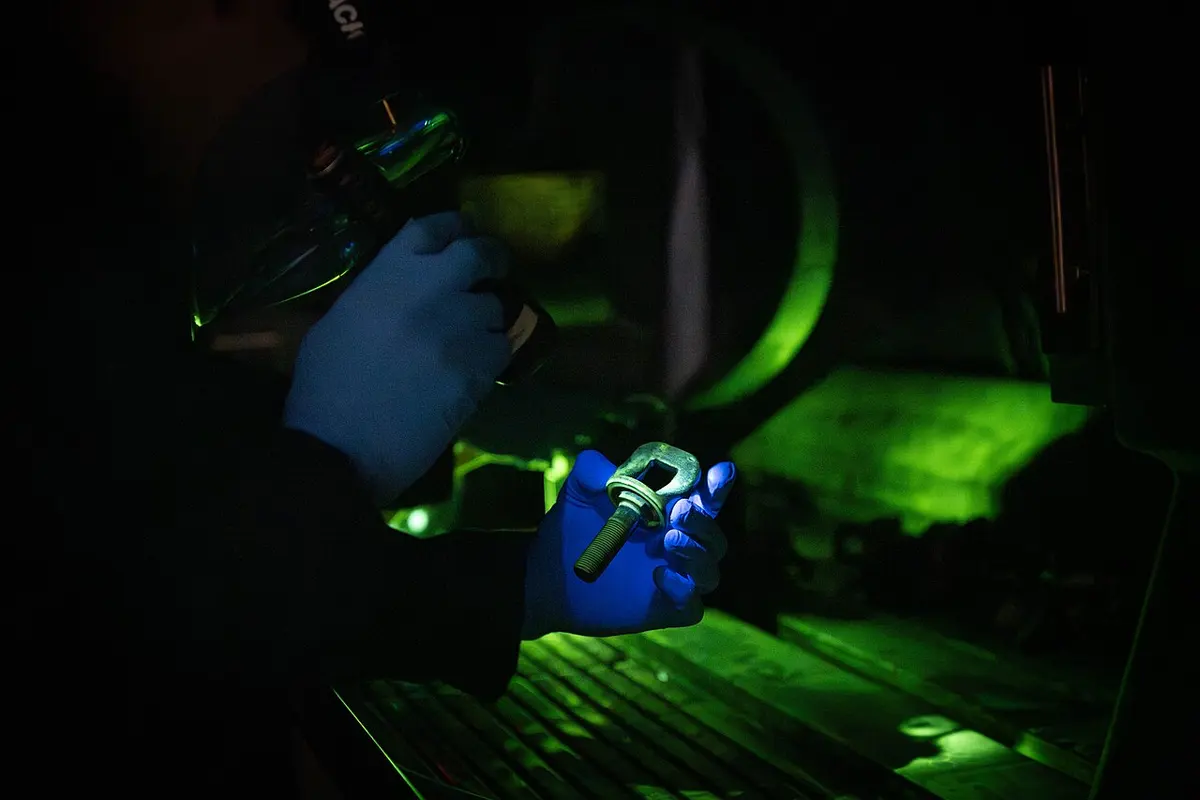
A titanium shop that takes aerospace work does not control only the cutting. It controls every special process the part passes through, including the ones done at an outside processor, and the control starts before the part leaves: choose a processor the customer accepts, flow the requirements down in writing, check the paperwork on return and decide who may change what. This post is a working method for the shop that cuts the part and sends out the etching, anodizing, heat treatment or inspection. Our reference page on Nadcap explains the accreditation itself, and our buyer guide to titanium aerospace parts covers the drawing and the documents.
This is a shop-side post. It sets no prices or terms: those are between you and the buyer, and the examples below are published terms of other companies, shown as wording and not as rules.
What counts as a special process
A special process is one whose result cannot be fully checked on the finished part without destroying it. One prime’s published supplier directive, Unison Industries QD 4.6.2.4 (revision of January 2024), puts seven categories under the heading: chemical processing, coatings, heat treat, nondestructive test, nonconventional machining, surface enhancement and welding. Its appendix lists examples inside each. For a titanium part the ones that come up most are these.
| Process | Examples the directive lists | Where it sits in a titanium route |
|---|---|---|
| Heat treat | Stress relief, aging, solution treatment | Before or after final machining, as the drawing or process specification says |
| Chemical processing | Anodizing, chemical cleaning, chemical milling, etching, passivation | As the drawing and specification set it, usually after machining |
| Nondestructive test | Liquid penetrant, ultrasonic, radiography, eddy current, magnetic particle | At the stage the specification names |
| Nonconventional machining | EDM, laser part marking, abrasive waterjet machining | As the drawing and route set it |
| Welding | Fusion, electron beam, friction, laser | As the drawing and specification set it |
Two things to notice. Chemical milling appears under both chemical processing and nonconventional machining in that list, so the same step can fall into two categories in a customer’s rules. And laser part marking is on the list, so a shop that marks its own parts is running a special process too. The sequence belongs to the drawing and the process specification. Do not reorder steps because it suits your schedule. Our posts on pickling and chemical milling, solution treated and aged titanium and anodizing explain what each step does to a titanium surface.
Step one: sort the route into in-house and outside
List every special process on the drawing and the purchase order, then mark each one as done in your shop or sent out. The marking matters because the rules follow it. A process you run yourself is audited as yours. A process you send out puts a second company between you and the customer.
For each outside process write down:
- The drawing note and the specification with its revision letter
- The category it falls into under the customer’s own list
- The processor you propose
- Whether the customer has to approve the processor in advance
If a step is vague, such as “heat treat per customer specification” or “passivate”, ask which specification and which revision before you quote. SAE AMS 2801D, for example, sets the engineering requirements for the heat treatment of titanium alloy parts and says material heat treated by producers, forge shops and foundries falls under AMS-H-81200 instead, so a drawing that says only “heat treat” leaves a real question open.
Step two: choose a processor the customer accepts
Primes handle this in different ways, so the first job is to find out which rule applies to your part.
- Nadcap category required. The Unison directive says it uses Nadcap accredited suppliers for special processes as its own customers flow it down, and that all suppliers and sub-tiers must either be Nadcap accredited for the category they perform or be on its approved processor list. For its own proprietary specifications, it says a processor needs the category accreditation but not the proprietary process in its scope.
- Accreditation required and cascaded. Airbus’s published policy says its suppliers must gain and maintain Nadcap accreditations relevant to their business with Airbus and cascade the requirements to their sub-tiers. Its table sets the accreditation commodities Airbus requires, such as chemical processing, heat treating, nondestructive testing and welding, and the year each business unit began requiring them.
- Grandfathering exists, and it ends. The Unison directive lets processors that were not Nadcap accredited on an earlier approved list stay in use for a part with an approved first article on file. It requires accredited processors once a change to the part prompts a new qualification. If you rely on a processor like that, find out what would end the exception.
Then check the processor. PRI says the Qualified Manufacturers List is open to the public and that accreditation decisions are made by the industry subscribers, not by PRI. Search the list for the processor’s site, match the process category, then read the scope of accreditation for the sub-process on your drawing. A nondestructive testing accreditation, for example, may cover penetrant and not ultrasonic. Accreditation is also a statement about a process at a site, not about your lot. It does not replace your own receiving check.
Step three: flow the requirements down in writing
The Unison directive is blunt on responsibility. A supplier that outsources special processes to a sub-tier remains responsible for final product quality and conformance to the technical and purchase order requirements, and it must flow those requirements down. It adds that where technical data is shared with the sub-tier, a signed nondisclosure agreement must be in place. The Boeing suppliers FAQ describes how Nadcap job audits check this: they trace a job from contract review to shipping and look at whether the process requirements were flowed down.
A purchase order to a processor for aerospace titanium work should carry, at least:
| Item | Why it is there |
|---|---|
| Part number and drawing revision | The processor works to the right revision |
| Specification and revision, with class or type | A drawing that says only “anodize” is not an instruction |
| Customer-specific requirements | Some primes add requirements above the base specification |
| Heat lot or lot number | Ties the processor’s records to your traveler |
| Certificate of conformance naming the specification | The Unison directive requires the certificate to identify the specifications the process was performed to |
| Records to send back | Furnace charts, bath analyses, inspection reports as the specification requires |
| No change without approval | Includes process parameters, processing site and sub-subcontracting |
| Report any nonconformance before shipping | Gives you and the customer the decision |
| Export control marking | If the drawing is controlled, see our post on export controls on titanium parts |
Need a quote for this part? Get a titanium quote
Step four: check what comes back
The processor’s paperwork is part of your product. On return, check the following before the parts move on:
- The certificate names the specification and the revision on your purchase order, not an older one.
- Quantity and part numbers match your traveler and the packing list.
- The lot is tied to the heat number. The processor’s records and your traveler should point to each other. Our post on heat lot segregation shows the chain.
- The records you asked for are there: furnace chart, bath analysis, inspection report.
- The parts look right. Colour, surface condition and marking are as expected, and anything odd is held until someone decides.
The Unison directive lists what a processor must keep as special process records: travelers and process sheets, material verification records such as films and metallography, employee training records, vision tests for operators and inspectors, and calibration records. It also says special processes must be documented on the part’s first article report and that the certifications go in the part qualification package. Your own first article report is therefore incomplete until the processor’s certificate is in the file. For nondestructive test, our posts on penetrant inspection and ultrasonic testing of bar describe what a good report looks like.
Where titanium punishes weak control
Titanium has its own risks inside these processes, and each is a reason for tighter flow down.
- Etching and hydrogen. Acid etching strips alpha case and smeared metal, and it is also a recognised route for hydrogen pickup. The control sits with the processor, so the drawing note and the specification must be explicit. See pickling and chemical milling.
- Heat treatment records. The drawing may call for a furnace chart, not only a certificate. Ask for it on the order, not after the lot is in the crate.
- Welding and alpha case. Welded titanium needs shielding and clean surfaces, and the defect is easy to miss. See welding and alpha case.
- Anodize colour and rework. Colour and surface preparation drive the result, and a strip and redo is a rework, so report it before you run it.
Change control and nonconformances
The Unison directive treats special process documents for flight safety items as frozen processes: parameters must not be changed without written approval from the prime, which may need its customer’s approval too. It also says nonconformances found in a special process must be communicated to the buyer through its supplier request before the affected hardware ships. Build both into your own order to the processor, as in the table above, and into your own procedure:
- A new processor, a new site or a new sub-subcontractor is a change of source, so ask first.
- Any change to a processor’s parameters needs the same approval route.
- A processor’s accreditation lapse mid-job needs a decision from you and the customer before more parts go.
- A nonconformance at the processor is reported before the parts come back to you or move on.
Keep the evidence. Every decision, request and approval belongs in the lot file, because a Nadcap-style job audit and a customer audit follow the paper from contract review to shipping.
Where to take this next
Shops that handle special processes carefully are the ones primes can approve with the least friction. Build one route sheet per part family that lists each process, its specification, the approved processor and the records to return, and keep it with the order.
If you cut titanium and want enquiries from buyers abroad who send drawings and quantities, read the page for shops and talk to us about whether it fits your shop. We hold no Nadcap, AS9100 or other certificate, and we do not vouch for any shop’s approvals.
Sources
- Unison Industries, Quality Directive QD 4.6.2.4, Supplier Special Processes and Special Process Control, revision 01/17/2024 (special process categories, sub-tier rules, flow down, records, change and nonconformance control; one prime’s published terms)
- Airbus, Supplier Nadcap Accreditation Policy, December 2023 (accreditation required and cascaded to sub-tiers)
- Boeing suppliers site, Nadcap Accreditation FAQ (special process commodities, job audits and flow down)
- Performance Review Institute, Nadcap program overview (24 accreditations, EAN platform and the Qualified Manufacturers List, subscribers decide)
- Performance Review Institute, Participate in Nadcap (the Qualified Manufacturers List is open to the public)
- SAE International, AMS2801D, Heat Treatment of Titanium Alloy Parts, revised March 2024 (scope and metadata)
Frequently asked questions
What counts as a special process on an aerospace titanium part?
A special process changes or checks a part in a way you cannot fully verify afterwards without destroying it. One prime's published supplier directive lists chemical processing, coatings, heat treat, nondestructive test, nonconventional machining, surface enhancement and welding. On a titanium part the usual ones are heat treatment, etching, anodizing and penetrant or ultrasonic inspection.
If I send a special process to an outside processor, who is responsible for the part?
You are. One prime's published directive says a supplier that outsources a special process to a sub-tier stays the responsible party for final product quality and conformance, and must flow the technical and purchase order requirements down to that sub-tier. Check the same clause in your own customer's terms, because primes differ.
Does the processor have to hold Nadcap accreditation?
Only if the drawing or the customer's terms say so, and primes differ. One directive accepts a sub-tier that holds Nadcap accreditation for the category or is on its own approved processor list. Airbus says it requires its suppliers to gain relevant accreditations and cascade the requirement to their sub-tiers. Ask your customer which rule applies to the part.
How do I check a processor's accreditation?
Search the Qualified Manufacturers List kept by the Performance Review Institute on its EAN platform. PRI says access to the list is open to the public. Match the site, the process category and the sub-process on your drawing, and check that the entry is current. A scanned certificate can be out of date, so trust the list over the scan.
Need a quote for this part?
Send the drawing. We send one itemised quote for the finished parts and reply within 24 business hours.
Get a titanium quote