Guides / For Shops
Cost of Poor Quality in a Titanium Shop: Scrapped Bar, Remakes and Air Freight
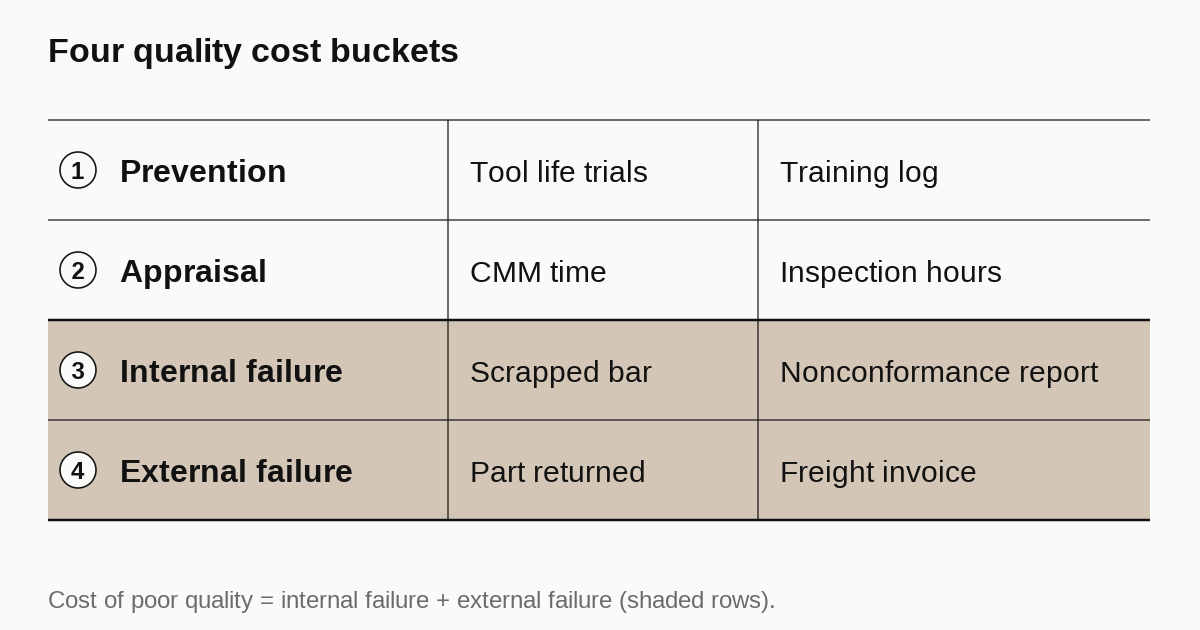
A titanium shop should count its cost of poor quality in the four buckets quality professionals use, pull each number from a record it already keeps and spend first on the prevention that removes the most expensive failure. In titanium that is usually a scrapped part found late, because the bar and the spindle hours are both gone.
This is for shop owners and quality leads. We own no machines and cannot see your books, so the sheet below is a template you fill with your own records. Our post on who pays when a titanium part is rejected covers the buyer side of the same event.
The four cost buckets: prevention, appraisal, internal failure, external failure
Armand Feigenbaum first described quality costs in a 1956 Harvard Business Review article, according to a general reference. Its four categories are still the common way to sort them.
| Bucket | What it is | Titanium example |
|---|---|---|
| Prevention | Spending to stop defects before they occur | Tool life trials, first-piece plan, heat number marking, training |
| Appraisal | Spending to find defects | Inspection and CMM time, certificate checks, lab tests |
| Internal failure | Defects caught before the customer | Scrapped bar, recut, remade part |
| External failure | Defects that reach the customer | Returned part, remake freight, late-delivery claim |
Prevention and appraisal are the cost of getting it right. Internal and external failure are the cost of poor quality, often shortened to COPQ. The same reference notes that spending more on prevention tends to reduce failure and appraisal costs, and that adding inspectors alone is never fully effective. A second reference credits the term cost of poor quality, as a refinement of Feigenbaum’s quality costs, to H. James Harrington’s 1987 book, and adds a layer of indirect costs borne by customers that are hard to measure. Joseph Juran described a variant that sorts costs by account type. The four buckets above are enough for a shop to start.
Titanium-specific failures
These are the failures that cost more here than in softer metals. For each, decide which bucket it belongs in.
- Scrapped bar. A part cut undersize or to the wrong revision cannot be put back. The bar and the spindle hours are both lost. The scrap value of the part and its chips credits some of it back, as we explain in our post on titanium scrap value.
- Alpha case rework. Titanium heated in air forms a hard, brittle surface layer called alpha case. A 2016 Stellenbosch University study found it readily removed by machining at all conditions tested, but at high cutting speeds it saw excessive notching and accelerated tool wear. The cost sits in extra passes, tools and inspection.
- Thin-wall distortion. A wall that moves after release from the fixture is a scrap or rework event. Our guide to thin-wall titanium parts shows where it starts.
- Remake freight. A remake that must beat a deadline often ships by air. That is external failure if the first lot reached the customer, internal if it was caught in your shop.
- Wrong heat or missing certificate. The part is good and the paperwork is not. The cost is rework of the documents, delay and sometimes a retest.
Getting the numbers from records you already have
Do not build a new system first. Look in these places.
| Cost | Where to find it |
|---|---|
| Scrapped bar | Nonconformance report with the heat number; bar invoice price per kg and weight of the blank |
| Spindle hours lost | Job cost sheet actual hours on the failed part, times your machine rate |
| Recut or rework | Rework instruction with hours |
| Inspection time | Inspector time sheet or CMM log |
| Remake freight | Freight invoice |
| Customer claim | Complaint file, credit note |
Keep one rule: every number needs a source record. If it does not, mark it estimated and keep it out of the total until it has one.
Need a quote for this part? Get a titanium quote
A monthly COPQ sheet
Copy this worksheet. One row per cost item, one sheet per month.
| Category | Item | Source record | Monthly cost |
|---|---|---|---|
| Prevention | Tool life trial on new Grade 5 job | Trial report, hours | |
| Appraisal | Final CMM inspection | Inspector time log | |
| Internal failure | Scrapped part, bar and machine time | NCR and job cost sheet | |
| Internal failure | Recut on oversize feature | Rework instruction | |
| External failure | Air freight for the remake | Freight invoice | |
| External failure | Customer credit | Credit note |
Sum internal and external failure for the cost of poor quality. Sum all four for the cost of quality. Compare month to month, not against another shop. We found no public benchmark for titanium shops, so any percentage of sales quoted without a source should be ignored.
Worked example (illustrative, assumed numbers). One Grade 5 bracket is found undersize at final inspection. Using the assumptions from our batch size post, the part used 4 kg of bar at 55 per kg, which is 220, and 1.5 hours of machine time at 85 per hour, which is 127.50. The scrap line is 347.50. The shop recuts two oversize features on another part, 1.5 hours at 85, 127.50. A remake goes by air at an assumed 90. The month’s cost of poor quality for these items is 347.50 + 127.50 + 90 = 565. Then credit the scrap value of the part and chips against the first line once the recycler has paid. None of this is data from a real shop; it only shows how the columns work.
Where prevention pays in titanium
Rank your failure lines by cost and by how often they repeat, then ask what check would have caught the most expensive one earliest.
- Wrong revision or heat. A heat number marked on the bar and parts and a revision check at job release cost minutes. See our post on heat lot traceability.
- Undersize found late. A first-piece measurement before the lot, and in-process gauging on the critical feature, move the find from the end to the start.
- Tool wear drift. A tool life trial and a tool change rule keep size inside the limit. Tool wear can creep a size out of the limit between checks.
- Distortion. A fixturing plan and a stress-relief step in the route before finishing.
Prevention costs are small and recurring. A failure costs a lot once. Put both on the sheet so the comparison is visible.
Showing buyers the improvement without numbers you cannot prove
Buyers do not need your cost figures. They need evidence that the causes are being removed.
- Count of nonconformances by cause, month by month.
- Corrective actions closed, with the check added to the route.
- On-time delivery and rejection records you can trace.
Do not publish a percentage unless a record backs it. A falling count with a named fix is more credible than a savings figure.
Talk to us
If your shop cuts titanium and keeps records like these, see how shop registration works. We send work requests for titanium parts to partner shops that cut the grade in question: the shop quotes us and we place the PO. There is no fee to join and no charge per request. Talk to us if you want to see a sample work request before you decide.
Sources
- Wikipedia, Cost of quality (Feigenbaum 1956, four categories, Juran variant)
- Wikipedia, Cost of poor quality (Harrington 1987, direct and indirect costs)
- Conradie, Oosthuizen and Sacks, feasibility of removing alpha case from titanium alloys by machining, Stellenbosch University, 2016 (abstract)
Frequently asked questions
What is the cost of poor quality in a machine shop?
It is the money spent because work was not right the first time: internal failure such as scrap and rework, and external failure such as returns, remakes and late-delivery claims. Some authors add prevention and appraisal to give the full cost of quality. The poor quality part is the failure costs.
Why is titanium scrap more costly than steel scrap?
We found no public figure comparing the two. The direction follows from the cost lines: titanium bar is a large share of the cost of each part and cycle times are long, so a scrapped part loses both material and spindle hours. Scrap value of the chips and the part credits some of it back, as our scrap value post explains.
Where do I get cost of poor quality numbers if I do not track them?
From records you already have: nonconformance reports, job cost sheets with actual hours, supplier invoices for bar and freight, and inspection time sheets. Start with one month and one machine. A rough number from real records beats an estimate.
Can I show buyers that quality improved without sharing figures?
Yes. Show the count of nonconformances by cause, the corrective actions closed and the checks added, without cost figures. Buyers read a falling count with a named fix as evidence. Do not publish a percentage you cannot trace to a record.
Need a quote for this part?
Send the drawing. We send one itemised quote for the finished parts and reply within 24 business hours.
Get a titanium quote