Guides / For Shops
ESG and Responsible Sourcing Questionnaires From Aerospace and Medical Primes: How a Titanium Shop Answers
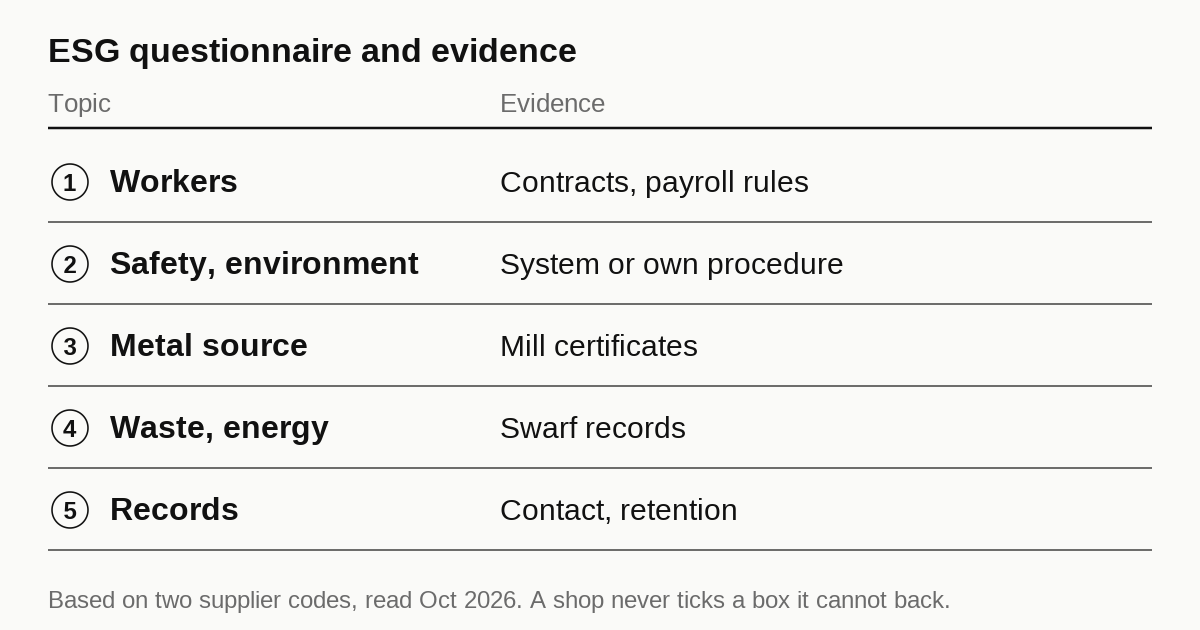
A responsible sourcing or ESG questionnaire from an aerospace or medical customer asks a titanium shop about five things: how it treats workers, what safety and environmental system it runs, where its metal came from, what it does with waste and energy, and what records it keeps. Most small shops can answer most of it from paper they already hold. The rule that protects you is simple: answer yes only with evidence, answer partly with a dated plan, and write no or not applicable where that is the truth.
This guide is for the owner or export sales engineer of a shop. We are not an auditor. We hold no certificate and give no assurance about any shop, and nothing here replaces the customer’s own form.
Why the questionnaire reaches you
Primes write their expectations into a supplier code and ask suppliers to carry it down the chain. The Boeing Supplier Code of Conduct (Rev. 2) says it expects suppliers to keep their own written code, consistent with Boeing’s, and to flow their principles down to the suppliers they use. Medtronic publishes a Global Supplier Code of Conduct and expects suppliers to track and report progress on it every year. So the questionnaire is the check on a document that is already part of your purchase terms.
Rules in Europe will add pressure from the other side. The EU Forced Labour Regulation applies from 14 December 2027 to every product on the EU market, and if an authority opens an investigation, an operator typically has 30 to 60 working days to answer information requests. An importer who cannot show where a titanium part came from in that time will ask its shop for the file early. Our 2027 compliance calendar sets out that date next to the others.
There is one counter-trend. The Omnibus I Directive, in force since 18 March 2026, limits the sustainability information that large reporting companies can request from value chain partners with fewer than 1,000 employees. How that limit meets the terms of a prime’s own supplier code is a question for counsel, so do not assume a questionnaire is optional.
What the codes ask, topic by topic
| Topic | What the Boeing code says | What the Medtronic pages say | What a shop can attach |
|---|---|---|---|
| Workers | Pay at least the legal minimum, regulated hours, written contracts in a language the worker understands, no recruitment fees, no holding of ID papers | Child and forced labour barred for suppliers and contractors | Contract template, payroll and hours policy, a written statement on fees and ID |
| Safety | A safety management system, ISO 45001 or equivalent | Safe and healthy workplace | Your safety procedure, incident log, training record |
| Environment | An environmental system, ISO 14001 or equivalent, with priorities and progress over time | Supplier Decarbonization Program: measure, manage and report emissions | Waste and coolant procedure, energy bills if you want to report them |
| Minerals | Responsibly sourced material, due diligence, and source data and chain of custody when requested | Tin, tungsten, tantalum and gold sourced responsibly | Mill certificates, mill declarations, the alloy list |
| Ethics and records | Anti-corruption, accurate records, a way to report concerns | Annual progress reporting | Code of conduct, record period, a named contact |
| Trade and parts | Import, export and sanctions rules, counterfeit parts controls, chemical content information | Not covered on the page we read | Export classification, material control procedure |
The RBA Code of Conduct, version 8.0 and effective 1 January 2024, is the third document you may see. It began in electronics and is used by other industries. Neither source above mentions it. The RBA also publishes a Self-Assessment Questionnaire, and a customer may send that instead, so treat it as one more format for the same facts.
The Boeing code also lists cybersecurity: it expects suppliers to follow a recognised framework such as ISO 27001 or the NIST Cybersecurity Framework. A shop that stores customer drawings should read that line before the questionnaire arrives, because a drawing file is what a customer shares with you.
Answers that are specific to titanium
Minerals. Titanium is not one of the four minerals the Medtronic page names. The trap is the alloy. Ti-6242, one of the high temperature grades covered in our alloy guide, has about 2 percent tin by nominal composition, while Ti-6Al-4V has none. If the customer’s form asks about tin, the honest answer names the alloy and refers to the mill’s declaration. Do not write that the shop has smelter data unless the mill has given it to you.
Metal source. The questionnaire may ask whether any metal comes from sanctioned or forced-labour sources. The proof sits in your receiving file: the original mill certificate with the heat number, and the mill and any trader named on it. When bar comes through a stockist, ask for the original mill certificate behind the stockist’s own paper, as set out in our mill certificate guide and the origin and sanctions page. A declaration is a statement of what you know, and it should rest on that file. No routine test tells you which country melted a heat.
Waste. Clean titanium turnings have real value, and a shop that cuts a lot of titanium usually keeps bins by alloy and sells the swarf to a recycler, as our scrap guide explains. If you do that, write it down with the name of the recycler and how often it collects. Mixed grades downgrade the remelt, so the segregation record doubles as a quality record. For chip handling and fire rules, see the chip fire guide.
Energy and emissions. A shop that has never measured its emissions should not invent a figure. If the questionnaire asks, answer with what you meter, such as monthly electricity use, and say that emission factors are not yet applied. Medtronic’s programme asks suppliers to measure, manage and report, so a plan with a date is a reasonable reply.
Traceability. A questionnaire from a medical customer often links to the quality system. Our pages on ISO 13485 and titanium parts and the approved supplier list show what customers check there. ESG answers and quality answers must agree: if the form says every part is traceable to a heat, the traveller has to show it, as in our heat lot guide.
Need a quote for this part? Get a titanium quote
How to answer in three states
- Yes, with evidence. Name the document and attach it or say where it is. A procedure that exists but is not followed is a no.
- Partly, with a plan. Say what is in place, what is missing and by what date you will close it. Keep that date.
- No or not applicable. Say it in plain words. If you hold no ISO 14001 certificate, write that, and describe your own system if you have one.
Write the answers once in a master file, dated, and reuse them across customers. When something changes, such as a new recycler or a new hours policy, update the master file first. Do not copy a customer’s wording into the answer to make it look closer to their code.
What goes in the master file
Keep one folder that every questionnaire draws from. It saves a week of searching each time a form arrives and it keeps your answers consistent between customers.
- A one-page policy on workers: pay, hours, contracts, fees and identity papers.
- Your safety and environmental procedures, with the date of the last review.
- The list of alloys you cut, with the mill certificate for the last heat of each.
- The names of your mills, stockists and outside processors.
- Your swarf record: grades, recycler, collection dates.
- The contact for raising a concern, and how long you keep records.
- A change log, so you can show when an answer was true.
Mistakes that cost an approved supplier place
- Ticking yes to an ISO line you meet only in spirit. Boeing says “or equivalent”, which lets you describe your system, not claim a certificate.
- Answering from memory. The form becomes a signed record. Check the file first.
- Answering the origin question from the stockist’s paper. If the original mill certificate is missing, say the chain stops at the stockist.
- Letting the form sit. An unanswered questionnaire can hold up an approval.
- Promising a policy you have not written. A one-page policy you follow beats a ten-page template you do not.
Where to take this next
A shop that wants buyers who send real titanium RFQs will meet these questions sooner or later. Read the page for shops and talk to us about whether our partner network fits yours, or write to and we reply within 24 business hours.
Sources
- Boeing Supplier Code of Conduct, Rev. 2 (boeingsuppliers.com)
- Medtronic, Supplier Standards and Policies
- Responsible Business Alliance, Code of Conduct (version 8.0, effective 1 January 2024)
- Baker McKenzie, EU publishes guidelines on the application of the Forced Labour Regulation (24 August 2026)
- Latham & Watkins, EU Sustainability Omnibus published in the Official Journal
- Our alloy guide, source of the Ti-6242 tin range (Titanium Industries composition limits)
Frequently asked questions
Why does a small titanium shop get an ESG questionnaire?
Primes put supplier codes of conduct into purchase terms and ask suppliers to pass the same principles to their own suppliers. Medtronic also asks suppliers to report progress each year. The code usually arrives with the approved supplier paperwork, not as a separate project.
Is titanium a conflict mineral?
The minerals named in the Medtronic policy are tin, tungsten, tantalum and gold, and titanium is not among them. An alloy can still carry one of them: Ti-6242 holds about 2 percent tin. Ask the mill what it declares for the alloy you buy and pass that on.
Do I need ISO 45001 or ISO 14001 to answer?
The Boeing code expects a safety management system such as ISO 45001 or equivalent and an environmental one such as ISO 14001 or equivalent. It does not say a certificate is the only proof. Describe the system you run, and state clearly whether you are certified.
What if I cannot answer a question?
Say so and say what you can offer instead, such as a plan with a date. A guessed or copied answer is worse than a gap, because you sign the questionnaire. A reply with a plan and a date beats silence.
Need a quote for this part?
Send the drawing. We send one itemised quote for the finished parts and reply within 24 business hours.
Get a titanium quote