Guides / Sourcing
Titanium Parts Rules for 2027: Sanctions, Export Control and Specialty Metals Dates in One Table
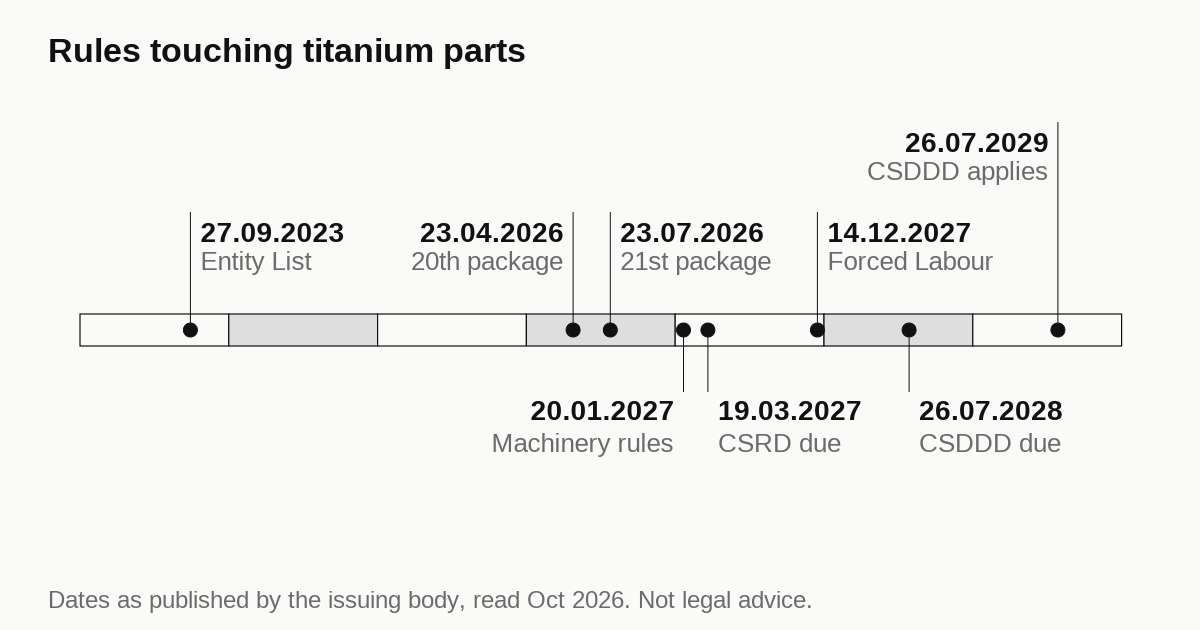
Several rules touch machined titanium parts in the next two years, and three of them carry a fixed date in 2027: the EU Machinery Regulation applies from 20 January 2027, the Member State deadline for the CSRD changes is 19 March 2027, and the EU Forced Labour Regulation applies from 14 December 2027. US specialty metals rules for defence work and the Russia sanctions packages are already running and move without a calendar. None of the summaries we read names titanium, so the work for a buyer is to ask the supplier for records, not to expect a new titanium rule.
This is not legal advice. Dates below come from the Federal Register, the DFARS text on acquisition.gov, and the European Commission, with law-firm notes where the official text would not open. We read them in October 2026. Confirm any date with your trade counsel before it drives an order.
The calendar in one table
| Rule | Applies or falls due | Who it hits | What it changes in your file |
|---|---|---|---|
| DFARS 252.225-7009 specialty metals | In force now, clause dated January 2023 | Contractors and subcontractors on covered US defence contracts | Titanium metal in the delivered item must be melted or produced in the US or a qualifying country, unless an exception applies |
| US Entity List, VSMPO-AVISMA | In force since 27 September 2023 | Anyone exporting items subject to the EAR to that company | Licence needed for all such items, with a policy of denial. It is an export rule, not an import ban |
| EU Russia sanctions, 20th and 21st packages | Adopted 23 April 2026 and 23 July 2026, more packages possible | EU importers and exporters | Metal import bans widened to ores, scrap and processed goods. We found no titanium line in the summaries |
| EU Machinery Regulation (EU) 2023/1230 | 20 January 2027 | Makers and importers of machinery sold in the EU | Machine makers redo their conformity files. A plain machined part is not machinery |
| CSRD changes, Omnibus I | Member States transpose by 19 March 2027 | EU companies above 1,000 employees and EUR 450 million turnover | Sustainability data requests, with a cap on what they can ask of partners under 1,000 employees |
| EU Forced Labour Regulation (EU) 2024/3015 | 14 December 2027 | All economic operators placing products on the EU market | Authorities can investigate a product and ask operators for records |
| CSDDD changes, Omnibus I | Transpose by 26 July 2028, comply from 26 July 2029 | EU companies above 5,000 employees and EUR 1.5 billion turnover | Due diligence duties for the largest buyers |
If you only read one row, read the one for the market you ship into. A US defence prime and an EU machine builder ask for different paper, and a shop that serves both has to keep two files.
Already running: specialty metals and the Entity List
DFARS clause 252.225-7009 is the rule most titanium buyers on US defence work already know. Its paragraph (b) says specialty metals incorporated into delivered items must be melted or produced in the United States, its outlying areas or a qualifying country. The clause lists titanium and titanium alloys as specialty metals, and it treats an alloy named for one metal as one that contains 50 percent or more of that metal by mass. Paragraph (c) lists exceptions, among them electronic components, items made in a qualifying country, a government determination that the metal cannot be had in the needed form and quantity, and a small allowance of noncompliant content. The acquisition.gov page shows the clause dated January 2023 and a DFARS change of 7 May 2026, and paragraph (b) carries no 2027 date.
What this means for an RFQ: the clause is in force or not depending on your prime contract, so the shop cannot decide it for you. Put the clause number on the purchase order if it applies, and ask for the melt source on the mill certificate. Our mill certificate guide shows which blocks to read, and the approved mills page explains why aerospace drawings name the source.
The Bureau of Industry and Security added VSMPO-AVISMA Corporation PJSC to the Entity List with effect from 27 September 2023, under footnote 3, which brings the military end-user foreign direct product rule into play. A licence is needed for all items subject to the EAR, with a policy of denial. That restricts what US firms and others subject to the EAR can send to the company. It does not, by itself, stop anyone importing titanium, which is why the origin and sanctions page treats it as a records question.
Sanctions packages: no calendar, so watch the annexes
The EU adopts Russia packages without a published schedule. The 20th package was adopted on 23 April 2026 and, according to a Mayer Brown summary, widened metal import restrictions to items such as iron ore, copper, processed aluminium goods and scrap of several metals. The 21st package was adopted on 23 July 2026. The Commission describes new import bans on metal ores and export bans on certain metal powders and alloys used in the aerospace sector and for drones. Neither summary mentions titanium.
That is not proof that nothing touches titanium. We could not open the consolidated Regulation 833/2014 on EUR-Lex, where the annexes with the product codes sit, so we cannot say which tariff lines are listed. The practical step is to have your customs broker check heading 8108 and the lines for titanium articles against the current annexes each time a package is adopted. Ask the shop for the same check on its own side, and keep the date of the last check in the order file.
20 January 2027: the Machinery Regulation
Regulation (EU) 2023/1230 was adopted on 14 June 2023 and applies from 20 January 2027. A corrigendum fixed a clerical error in the application dates in the first printed version, so use the corrected date. Machinery placed on the EU market before that day stays under Directive 2006/42/EC.
The Regulation revises the definitions of machinery and safety component and adds a category of related products. For a buyer of machined titanium parts the effect is indirect. The duty to prove conformity sits with the machine maker or importer. A plain bracket, fitting or shaft is not machinery, and whether a part counts as a safety component is a legal call for whoever builds the machine. Where your part goes into equipment sold in the EU, expect your customer to review its supplier requirements around the date, and ask early what material and inspection records it wants.
19 March 2027 and the CSRD: why a small shop gets a questionnaire
The Omnibus I Directive was published in the Official Journal on 26 February 2026 and entered into force on 18 March 2026. It narrows CSRD to EU groups with more than 1,000 employees and more than EUR 450 million net turnover, and Member States must transpose those changes by 19 March 2027. The amendments also limit the sustainability information a reporting company can request from value chain partners with fewer than 1,000 employees, which includes small machine shops. The CSDDD changes follow later: transposition by 26 July 2028 and compliance from 26 July 2029, for companies above 5,000 employees and EUR 1.5 billion turnover.
So a large buyer still asks questions, but it has less room to ask a small shop for a long data set. A buyer above the threshold should keep its request short and tied to what it must report. We took the figures from a Latham & Watkins summary, not from the Official Journal text, so check the Directive before you quote a threshold.
Need a quote for this part? Get a titanium quote
14 December 2027: the Forced Labour Regulation
Regulation (EU) 2024/3015 applies from 14 December 2027 to all economic operators and all products on the EU market, whatever the sector or origin. The Commission adopted its guidelines on 26 June 2026, with the notice published in the Official Journal on 3 September 2026. Authorities choose cases on risk, using the scale and severity of the suspected forced labour, the volume of the product on the EU market and the share of the suspect part in the final product. A Baker McKenzie summary reads the guidelines as imposing no formal due diligence duty while treating documented due diligence as useful evidence, with the OECD six-step framework as the benchmark.
The deadlines matter for a titanium importer. In an investigation, operators typically have 30 to 60 working days to answer information requests, and the authority has 30 working days after the replies to decide whether a concern is substantiated. A chain you cannot document in that time is a problem even if nothing is wrong with it. For titanium parts the useful file is short:
- The mill that melted each heat and any trader between the mill and the shop.
- The shop and each outside processor that touched the part, such as heat treat, anodising and inspection.
- The heat number carried to the part, as in our heat lot traceability guide.
- The date and result of your last check of the supplier.
What is not on the calendar
No Section 232 action names titanium. Proclamation 11001 on processed critical minerals, signed 14 January 2026 and published in the Federal Register on 20 January 2026, orders negotiations and an update within 180 days, and it reserves tariffs and minimum import prices for later. It does not mention titanium, and we found no later action that does. If a titanium measure appears, it will come with its own date, and we will not guess one here.
Export control also has no 2027 date, but it applies to every drawing: the guide to EAR and ITAR shows the order of review. For price effects, see the 2026 bar price guide.
What to write on the RFQ for 2027 work
- Market and clauses: the destination market, and any DFARS or customer flow-down clause by number.
- Origin record: mill name, heat number and melt country if the clause or the customer needs it.
- Chain list: every outside processor the shop will use, named before the order.
- Records period: how long the shop keeps the file, since a question can arrive years after delivery.
- Change notice: a rule that a change of mill or processor after quote needs your approval.
We hold no certificate, we do not audit origin and we do not give legal advice. Send the drawing through the RFQ form and shops that cut titanium reply within 24 business hours.
Sources
- DFARS 252.225-7009, Restriction on Acquisition of Certain Articles Containing Specialty Metals (acquisition.gov)
- Federal Register, Entity List additions of 27 September 2023, document 2023-21080 (govinfo)
- Federal Register, Proclamation 11001, Adjusting Imports of Processed Critical Minerals and Their Derivative Products, 20 January 2026 (govinfo)
- European Commission, Machinery Regulation page
- European Commission, EU adopts 21st package of sanctions against Russia, 23 July 2026
- Mayer Brown, EU adopts 20th package against Russia (April 2026)
- Baker McKenzie, EU publishes guidelines on the application of the Forced Labour Regulation (24 August 2026)
- Latham & Watkins, EU Sustainability Omnibus published in the Official Journal
Frequently asked questions
Does the EU Forced Labour Regulation ban titanium parts?
It names no metal. From 14 December 2027 it applies to all products on the EU market, whatever the sector or origin. Authorities pick cases on risk, and a documented chain from mill to shop is the evidence that helps an importer answer an information request.
Is Russian titanium banned in the EU or the US?
We could not confirm a ban. The summaries of the 20th and 21st EU packages that we read do not name titanium, and the US Entity List entry for VSMPO-AVISMA restricts exports to it, not imports. We could not read the EU annexes on EUR-Lex, so check them before you rely on this.
What does the DFARS specialty metals clause mean for titanium?
Titanium and titanium alloys are specialty metals under DFARS 252.225-7009. On a covered defence contract the metal in the delivered item must be melted or produced in the United States or a qualifying country, unless an exception in the clause applies. Your prime contractor tells you whether the clause is in your order.
Do I need new documents from a titanium shop on 20 January 2027?
None of the summaries we read names a titanium-specific document for the Machinery Regulation. Machine makers update their own technical files, and they may then ask suppliers for material and inspection records. If your part goes into machinery sold in the EU, ask your customer what it needs.
Need a quote for this part?
Send the drawing. We send one itemised quote for the finished parts and reply within 24 business hours.
Get a titanium quote