Guides / Cost
Titanium Machining Minimum Order Quantity: Samples, First Lots and What Sets the Minimum
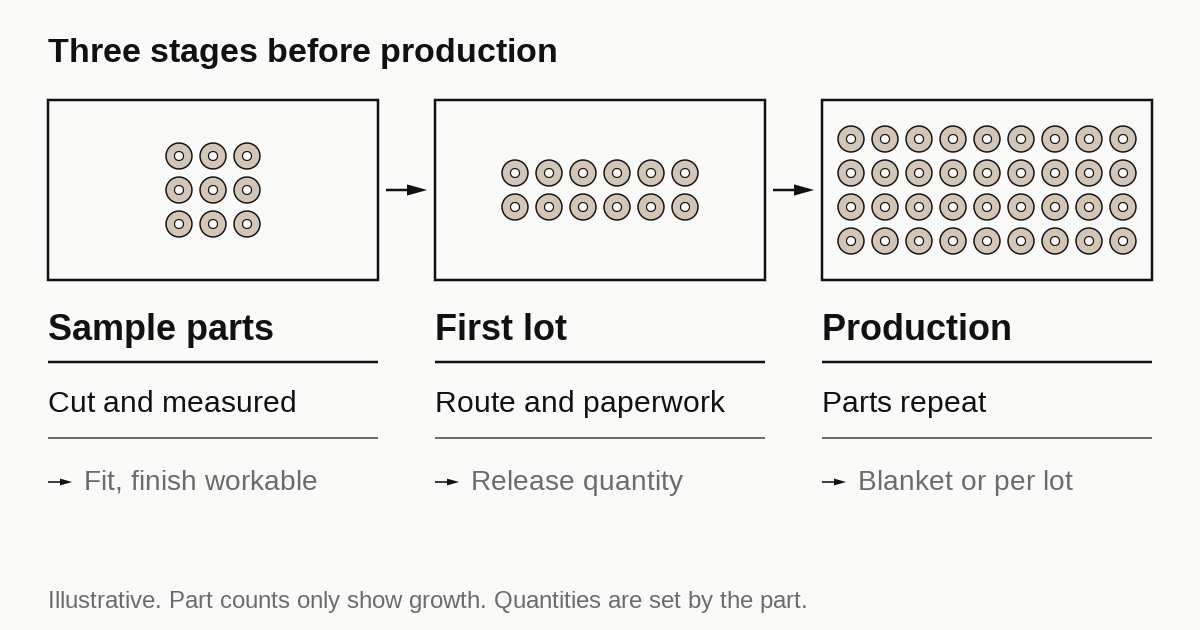
Titanium machining minimum order quantity is rarely one number. Many shops will quote a single piece, but three separate minimums sit behind that quote: the bar the shop must buy, a minimum order charge some shops apply and the setup that costs the same for one part as for ten. This post separates the three, shows how to stage sample parts before a production order and lists what to ask so a sample approves what you think it approves.
We own no machines, we name no shop and we do not set minimums: each shop that quotes states its own. The examples below are published terms of other companies, shown as the shape of the wording and not as a standard.
Three minimums behind one question
| Minimum | Where it comes from | What the buyer sees |
|---|---|---|
| Bar | The stock the shop has to buy to cut your part | A material line that does not fall as fast as the quantity rises |
| Order charge | A minimum order value some shops apply | A floor on the total, whatever the quantity |
| Setup | Programming, fixtures and first article, paid once per job | A high price per part at one piece, falling as the batch grows |
Of the three, the third is the one buyers feel most. Our posts on why five prototypes cost so much each and on batch size and price breaks work the arithmetic, so we do not repeat it here.
The bar minimum
We found no published mill minimum we could open, so we do not quote one. What distributors publish is the other side. Titanium Industries, for example, says it stocks round bar from 0.125 inch to 12 inches in diameter and offers custom cut lengths on request, which suggests a shop can buy a short length of a stocked size instead of a full bar. Ask the shop whether it does. Its page states no minimum order and no lead time.
Two things follow for you:
- A stocked size and grade can be cut to the length you need. An unusual diameter, grade or certificate may mean buying a full length or placing a mill order. The stock forms post shows which cases tend to fall on which side.
- The shop prices the bar it buys, not the bar in your part. A small order from a large bar still carries the offcut unless the shop can use it on another job. Ask which stock size was priced.
The order charge
Some shops apply a minimum order value. One published example is Avalon’s quote terms, revision 4/15/2024, which state a minimum order amount of 500 US dollars. That is one manufacturer’s wording for its own business, not a titanium figure and not an industry rule, but it shows what to look for: a floor on the invoice that has nothing to do with your part. Avalon’s terms also say that prices and lead times follow the prevailing price of material at shipment and that pricing can be renegotiated if raw material, purchased components or outside processing rise by more than 4 percent. A small titanium order is the kind most exposed to those clauses, because the bar is bought in a different month from the quote. Our post on quote validity shows how shops handle that.
Outside processes can carry their own minimum lot charge. We found no public figure for titanium anodizing or inspection, so ask the shop whether your processing line includes one.
What a sample is for
A sample order has a job. Decide which job before you pick a quantity.
| Stage | What it proves | Decision at the end |
|---|---|---|
| Sample parts | The drawing can be cut and measured | Fit, finish and tolerance are workable |
| First lot | The route, the paperwork and the packing work at quantity | Release a production quantity |
| Production | Repeat parts hold from lot to lot | Blanket order or lot by lot |
A sample does not prove the paperwork unless it carries it. If production parts will ship with a mill certificate and an inspection report, the sample should too. Otherwise the first lot is the first time the buyer sees the certificate, and the first lot is the wrong time to find a gap. Our guide to mill certificates lists what the certificate has to show.
Need a quote for this part? Get a titanium quote
Keep the sample and the production route the same
A sample approves only what it was made from and by. GKN Aerospace’s guidance on AS9102 first article reports says a full or partial first article is needed again after a design change affecting fit, form or function, a change in manufacturing source, process, inspection method, location, tooling or materials, a change in the NC program, a corrective action to complete an earlier incomplete report and a production lapse of two years. The same guidance asks for copies of the original mill certifications, with no material substitution unless approved.
Read that list as a warning about samples. If the sample was cut on a different machine, from a substitute bar or by a different shop than production, the approval does not carry over. Nikon AM Synergy’s published supplier terms add that a supplier may not submit production parts before the buyer accepts the first article, when the order requires that acceptance. For you, the practical rules are:
- State on the RFQ whether the sample is a prototype or a first article of the production route.
- Ask which machine type, bar source and process the sample used and whether production will differ.
- Keep the drawing revision of the sample and the production order identical. See drawing revision control.
- If the sample was rushed on a substitute bar, say so in the approval and plan a new first article at the start of production.
How many pieces
There is no standard count. Choose by what the pieces are for.
- One piece shows the drawing can be cut and measured. It cannot show repeatability.
- A handful shows that the process repeats and allows a destructive test, a fit check and a spare. Ask for the next quantity up in the same quote, since the second quantity often costs little more per part than the first.
- A lot at your intended batch size is a first lot, not a sample. It tests the route, packing and paperwork at the scale you will run.
If assemblies or tests consume parts, count those first and add a spare. Titanium bar is a large share of each part’s cost, so scrap is expensive; our post on reducing titanium machining cost shows where the other levers sit.
What to ask before you order
- What is the minimum order value, and does it apply to my total?
- Which stock size is priced, and can a shorter length be bought?
- How is the price quoted at 1, at the next quantity and at the production quantity?
- Is outside processing subject to a minimum lot?
- Is the sample made on the production route, and what would change in production?
- What documents ship with the sample, and which ship with production?
- How long is the quote valid, and what can move before the order?
What to put on the RFQ
Give the quantity for the sample, the intended production quantity and how often it repeats. Say whether the sample is a prototype or a first article, and list the documents you want with each. Send the drawing through the RFQ form and we reply within 24 business hours with one itemised quote that states the minimums.
Sources
- Titanium Industries, titanium round bar: sizes and custom cut lengths
- Avalon, quote terms, revision 4/15/2024 (one manufacturer’s published terms, including a minimum order amount)
- GKN Aerospace, AS9102 first article inspection report common mistakes, revision A, March 2022
- Nikon AM Synergy, supplier terms and conditions F020 Rev F (first article before production parts)
Frequently asked questions
What is the minimum order quantity for titanium machining?
Often one piece, but at a price per part that carries the whole setup. Three separate minimums sit behind the question: the bar the shop has to buy, a minimum order charge some shops apply and the setup that does not shrink with quantity. We found no public minimum that applies across shops, so ask each shop for its own.
Can I order one titanium part?
Many shops quote one piece, and a one-off is the normal route for a prototype. Expect the price to be mostly setup and bar. Our prototype post shows the arithmetic. A shop may also apply a minimum order value, which one published example sets at 500 US dollars for its own business.
How many sample parts should I order?
Enough to prove what you need to prove. One piece shows the drawing can be cut and measured. A handful shows the process repeats. If assemblies or tests consume parts, count those first. Ask the shop for a quote at one quantity and one slightly higher, because the second often costs little more per part.
Do samples have to be made the same way as production parts?
They should be. A change in source, process, inspection method, tooling, material or NC program can trigger a new full or partial first article inspection under AS9102, according to one aerospace supplier's guidance. A sample cut on different equipment or from different bar than production approves less than it appears to.
Need a quote for this part?
Send the drawing. We send one itemised quote for the finished parts and reply within 24 business hours.
Get a titanium quote