Guides / Choosing a Supplier
Measuring a Titanium Supplier's On-Time Delivery: Promised vs Confirmed Dates
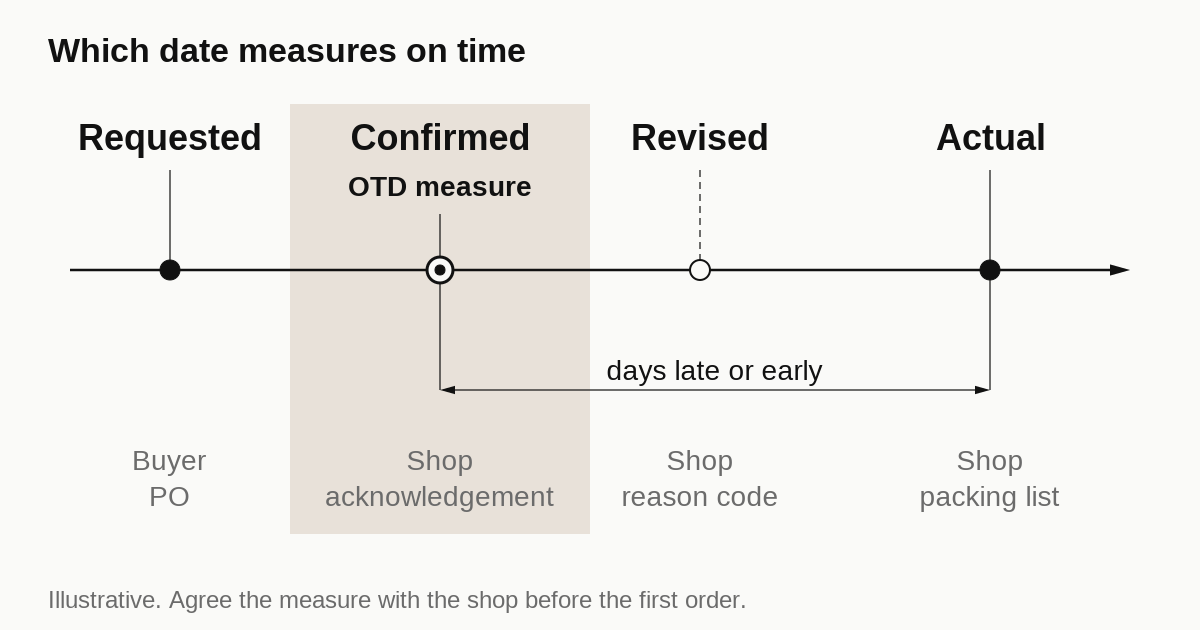
Measure titanium supplier on-time delivery against the date the shop confirmed, counted per order line, with every miss tagged by cause. Most arguments about lateness come from three people holding three dates: the one you asked for, the one the shop acknowledged and the one it later revised. Once you pick one date and write it into the order, the percentage means something and the conversation with the shop gets short.
We own no machines, so this is a method you can use with any shop, not a service we perform. It sits beside our guide to titanium stock forms and lead time, which explains why the bar sets most delivery dates.
Promised, confirmed and actual dates
Every order line carries up to four dates. Keep all of them, because each answers a different question.
| Date | Who sets it | What it tells you |
|---|---|---|
| Requested | You, on the PO | What the project needs |
| Confirmed | The shop, in the order acknowledgement | What the shop agreed to after checking bar and capacity |
| Revised | The shop, with a reason | How often and by how much the plan moved |
| Actual ship | The shop, on the packing list | What happened |
The requested date is a wish until the shop accepts it. A shop that quotes a date before it has checked whether the bar size is on a shelf is guessing, and the confirmed date should come after that check. In a quality system the check is a review of the order before the shop commits to supply: a secondary summary of ISO 9001:2015 clause 8.2.3 describes a review that happens before the organisation commits and resolves any unclear requirement with the customer. Ask your shop whether that review includes bar availability for the size you ordered.
Which date the metric uses and why
Use the confirmed date. If you measure against the requested date, you punish the shop for a date it never accepted and it will stop confirming dates. If you measure against the revised date, every miss disappears, because a shop can revise until it hits.
The rule that works: the first confirmed date is the measure, revised dates are logged with a reason, and the actual ship date is compared with the first confirmed date. If you changed the order after it was confirmed (quantity, grade, drawing revision), say so in the log and reset the confirmed date by agreement, in writing.
The formula for a period, per line:
On-time lines divided by total lines shipped in the period, multiplied by 100. A line is on time when the actual ship date is on or before the first confirmed date.
Write the formula into the order terms. There is no single industry definition: a logistics glossary from Penske notes that shippers differ, with some counting arriving a minute early or late as a miss and others counting any delivery on the right day. Pick one and put it in writing.
Counting partial shipments and early deliveries
Titanium orders often ship in parts: a first lot to start your line and the rest later. Decide before the order how a split counts.
- Count by line and by quantity. A line shipped half on time and half late is one half-late line, not a clean pass. Many buyers split the line in the log so each shipment has its own date and quantity.
- If you asked for a split, confirm one date for each lot. Do not penalise the shop for a second lot you never gave a date.
- State an early window. Titanium parts come with certificates and inspection records, and an early shipment can arrive before your receiving inspection can use it. A window such as “no earlier than three working days before the confirmed date” is easy to agree and easy to check. The window is a choice you make, not a standard.
Tracking table
Copy this into a spreadsheet. One row per shipment.
| PO | Line | Confirmed date | Revised date (if any) | Ship date | Days late | Cause code | Note |
|---|---|---|---|---|---|---|---|
| 4501 | 10 | 2026-11-12 | none | 2026-11-12 | 0 | none | |
| 4501 | 20 | 2026-11-12 | 2026-11-26 | 2026-11-27 | 15 | BAR | Mill order, size not in stock |
| 4502 | 10 | 2026-11-19 | none | 2026-11-24 | 5 | SHOP | Second machine down |
| 4503 | 10 | 2026-12-03 | none | 2026-12-01 | -2 | none | Early, inside window |
The numbers are an example, not data from any shop. Days late is ship date minus first confirmed date, so a negative number means early. Cause codes should be few. A workable set is BAR (material late), SHOP (capacity or machine), OUTSIDE (anodising, heat treatment or testing), DOC (certificates or inspection report), CHANGE (your own change) and OTHER with a note.
Need a quote for this part? Get a titanium quote
Separating bar delays from shop delays
Titanium delivery is often about the bar, not the machine. Our lead time guide gives mill order lead time as typically weeks rather than days, and it is the longest line in the build-up. That makes the cause code worth more than the percentage.
For each BAR miss, ask the shop two dates: when it placed the bar order and when the bar arrived. Three patterns show up.
- Bar ordered after the PO was confirmed and arrived on the mill’s date. The date was wrong when confirmed. The shop should have checked stock first.
- Bar ordered late, after the shop’s own delay. The cause is the shop’s planning, not the mill.
- Bar ordered on time and the mill missed. A shop miss on paper, a supply chain miss in practice. Look at whether the shop warned you and offered a different size.
Do not treat all three as the same. The first two go on the shop’s record. The third goes on the record with a note, and the question becomes what the shop did about it.
Reviewing the numbers with the shop
Send the table, not a complaint. A short review once a quarter, or after every five orders, is enough for a small buyer.
- Show the percentage and the list of misses with cause codes.
- Ask what changed for each SHOP and BAR miss: a different stock policy, a safety margin on the date, a second bar source.
- Ask whether the confirmed dates were realistic, and agree a change if they were not. A shop that confirms longer dates and meets them is easier to plan with than one that confirms short dates and slips.
Clause 8.4.1 of ISO 9001:2015, as a secondary summary describes it, expects a buyer to set criteria for evaluating external providers and to monitor their performance, with records kept. A tracking table like the one above is one way to keep that record. We have not read the standard itself, so check the clause wording if an audit depends on it.
When a falling on-time record means change supplier
A single miss is information. A pattern is a decision. Signs that the shop will not fix it:
- The same cause code repeats after a written plan.
- Dates move without a warning message.
- Misses happen with the bar in the building.
- The shop stops confirming dates or confirms only the requested date without checking.
Before you move, check whether the miss was yours: late drawings, a revision change after confirmation or an unclear certificate list all push dates, and they are CHANGE misses. Then compare against your own earlier orders with the same shop. We found no reliable public benchmark of titanium machining on-time rates, so we give none; a percentage from another buyer’s shop tells you little about yours.
If you decide to move, send the drawing and the history through the RFQ form. We reply within 24 business hours with one itemised quote, and you can ask for the confirmed-date practice. Our guide to choosing a titanium machining supplier covers the other questions to ask.
Sources
- Penske Logistics, glossary entry on on-time delivery (definitions vary between shippers)
- The Core Solution, ISO 9001:2015 clause 8.2.3 explained (secondary summary; standard not read)
- The Core Solution, ISO 9001:2015 clause 8.4.1 explained (secondary summary; standard not read)
Frequently asked questions
Which date should titanium supplier on-time delivery be measured against?
Use the confirmed date, the one the shop accepted in writing after checking bar and capacity. The requested date is only your wish until the shop agrees. Keep revised dates in a separate column so a slipping date is visible instead of rewriting history. Agree this in writing before the first order, because definitions of on time vary between companies.
Should a shipment that arrives early count as on time?
Decide in the contract. A strict measure counts early as a miss, a lenient one counts anything on or before the day. For titanium, early is rarely a problem unless it breaks a certificate or inspection plan. A common choice is a window of a few days early and zero days late, stated in the order.
How do I separate a bar delay from a shop delay?
Give every late line one cause code and ask the shop for the date it ordered bar and the date the bar arrived. If the bar was ordered after the PO was confirmed and still came late, the cause is material. If the bar was in the building and the part still shipped late, the cause is the shop. Review the codes, not only the percentage.
When does a falling on-time record mean changing supplier?
When the same cause repeats after a written corrective plan and the plan does not move the numbers across several orders. One late bar order is a lead time lesson. Lateness with the bar in stock, no warning and no new date is a process problem. Compare against your own earlier orders with the same shop, not against a published benchmark.
Need a quote for this part?
Send the drawing. We send one itemised quote for the finished parts and reply within 24 business hours.
Get a titanium quote