Guides / Grades
Is Titanium Magnetic? What a Magnet Can and Cannot Tell You
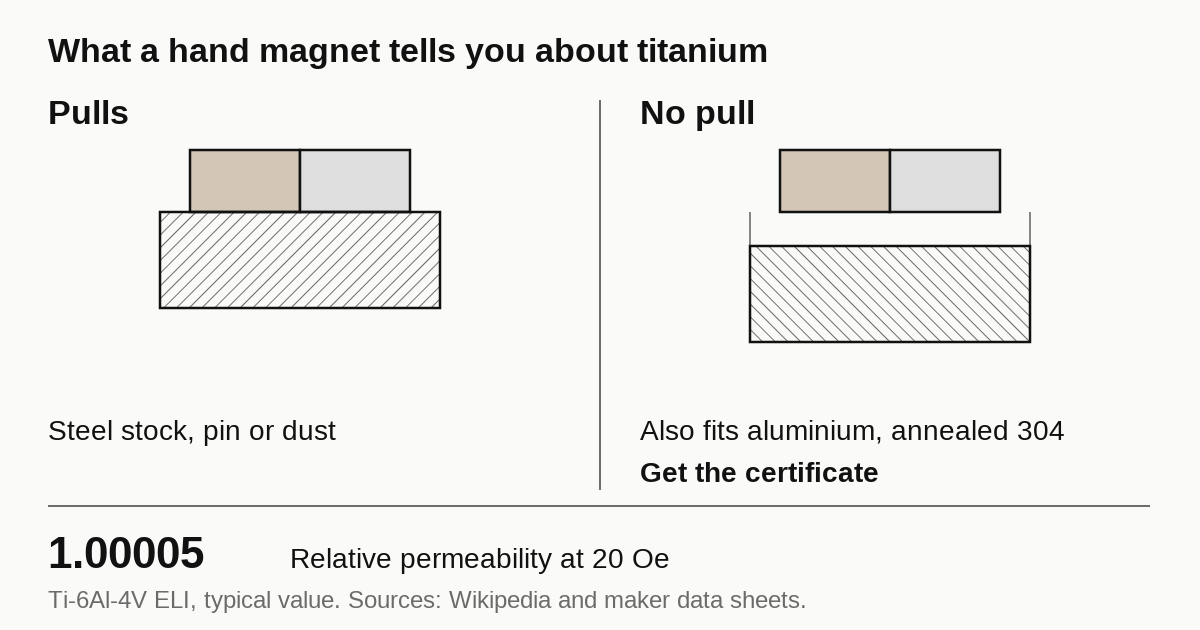
Is titanium magnetic? Not in the everyday sense: a hand magnet does not stick to it. It is paramagnetic, a very weak attraction that only sensitive instruments can measure. That makes a magnet a quick way to catch steel mixed into a batch, and a poor way to prove that a bar is titanium.
This guide gives the numbers from the datasheets we read in October 2026, then sets out what a magnet test proves on incoming parts. For the full incoming checks, see the guide to choosing a titanium machining supplier.
What paramagnetic means
Wikipedia defines paramagnetism as a weak attraction to an applied field, caused by unpaired electrons, that disappears when the field is removed. It says the attraction is weak enough that a sensitive balance or a SQUID magnetometer is needed to detect it, while ferromagnets such as iron are attracted much more strongly. It lists titanium and aluminium among paramagnetic materials. For the element titanium, Wikipedia gives a molar magnetic susceptibility of +153.0 × 10⁻⁶ cm³/mol at 293 K.
What the alloy datasheets say
The datasheets we opened are for Ti-6Al-4V, the alloy behind most machined titanium parts.
| Source | Material | Magnetic figure | Wording in the source |
|---|---|---|---|
| United Performance Metals datasheet | Ti-6Al-4V ELI | relative permeability 1.00005 at 20 oersteds | listed as a physical property |
| United Performance Metals web datasheet | Ti-6Al-4V Grade 5 | no figure | “non-magnetic, two-phase alloy” |
| Aubert & Duval datasheet | TA6V (Ti-6Al-4V) | absolute permeability 1.26 × 10⁻⁶ H/m | listed as a physical property |
Source: the three datasheets under Sources. A relative permeability of 1 would be the value of empty space. The vacuum permeability is about 1.2566 × 10⁻⁶ H/m, so the Aubert & Duval figure, rounded to three digits, is too coarse to separate titanium from vacuum. Treat both rows as “almost exactly non-magnetic”.
We did not open a magnetic figure for Grade 2 or for the beta alloys such as Ti-5553. Grade 2 is commercially pure titanium, so the element figure above is the nearest source, but we state it as an assumption and not a datasheet value.
What a magnet test tells you
A hand magnet is a sensitive detector for ferromagnetic material and a blind one for weak paramagnets. That sets the logic:
- A pull means something ferromagnetic is there. It could be steel stock mixed into the batch, a steel pin or insert, or steel dust on the surface. The part needs a second look.
- No pull is what titanium should do. It does not prove titanium. Aluminium is also paramagnetic, per the same Wikipedia list, and Wikipedia says 304 stainless is austenitic and therefore not magnetic.
- A weak pull does not point to titanium. Wikipedia says austenitic stainless steels, which are usually non-magnetic, can become slightly magnetic through work hardening, and that magnetism can appear along a bent or cut edge. A faint pull on a machined stainless part is therefore not evidence of anything about titanium.
So the magnet answers one question, “is iron or steel present?”, and nothing about grade, heat or condition.
A simple weight check that does more
Weight is a second cheap check if you know the density. ATI gives 4.47 g/cm³ for Ti-6Al-4V and 4.51 g/cm³ for commercially pure grades, a difference of less than 1 percent. A round bar 50 mm in diameter and 300 mm long has a volume of about 589 cm³ and weighs about 2.63 kg in Ti-6Al-4V and 2.66 kg in a pure grade. Weight will not tell the two titanium grades apart, and we did not open densities for the metals a mix-up would more likely involve, so use it only against a calculated figure for the grade on the drawing.
Need a quote for this part? Get a titanium quote
What proves the material
The mill certificate names the grade, the heat and the specification, and the certificate guide shows how to read it. A chemistry check by the shop or a lab confirms that the bar matches the certificate, and our reference page on incoming inspection of titanium parts lists what a buyer can ask for. Cleaning is a separate question: ASTM B600 is a guide to descaling and cleaning titanium surfaces, and it sets no limit for iron on a surface, so state your requirement on the drawing if iron on the surface matters to the part.
When the magnet matters
Some parts need to be non-magnetic as a function, for example near sensitive sensors. In that case ask for a measurement, not a hand test, and state the permeability limit and the test method on the drawing. If you are unsure how to write it, send the drawing through the RFQ form and we reply within 24 business hours with one itemised quote, made by a partner shop that cuts titanium.
Where the magnet fits in supplier checks
Use the magnet to rule out steel, then rely on paperwork and chemistry for the rest. Our guide to choosing a titanium machining supplier shows where these checks sit in the buying sequence.
Sources
- Wikipedia, Titanium: paramagnetic, molar susceptibility, read 25 October 2026
- Wikipedia, Paramagnetism: definition, strength, titanium and aluminium listed, read 25 October 2026
- United Performance Metals, Ti-6Al-4V ELI datasheet: magnetic permeability 1.00005 at 20 oersteds
- United Performance Metals, Ti-6Al-4V Grade 5 datasheet: “non-magnetic, two-phase alloy”
- Aubert & Duval, TA6V datasheet: absolute magnetic permeability 1.26 x 10⁻⁶ H/m
- Wikipedia, Stainless steel: austenitic grades usually non-magnetic, slightly magnetic after work hardening
- ATI, Ti-6Al-4V Grade 5 technical data sheet: density 4.47 g/cm³
- ATI, CP Grade 1 to 4 technical data sheet: density 4.51 g/cm³
- Wikipedia, SAE 304 stainless steel: austenitic, therefore not magnetic
- ASTM B600-22, Standard Guide for Descaling and Cleaning Titanium and Titanium Alloy Surfaces
Frequently asked questions
Is titanium magnetic?
No, not in the way steel is. Titanium is paramagnetic, which means a very weak attraction that only sensitive instruments detect. A hand magnet does not stick to it. The Ti-6Al-4V ELI datasheet we read gives a relative permeability of 1.00005, and a distributor sheet calls Ti-6Al-4V non-magnetic.
Can I use a magnet to check that bar is titanium?
Only to rule out iron and steel. If the magnet pulls, the material is not titanium, or something ferromagnetic is on or in it. If it does not pull, the bar could still be aluminium or annealed austenitic stainless. A mill certificate and a chemistry check are what confirm the grade.
Why would a magnet stick to a titanium part?
Most likely something ferromagnetic is present: steel dust or chips on the surface, a steel insert or pin, or a mix-up of stock. Clean the part and test again. If the pull stays, treat it as a nonconformance and ask the shop for the heat record and a chemistry check.
Need a quote for this part?
Send the drawing. We send one itemised quote for the finished parts and reply within 24 business hours.
Get a titanium quote