Guides / Grades
Titanium Melting Point by Grade and What It Means in the Shop
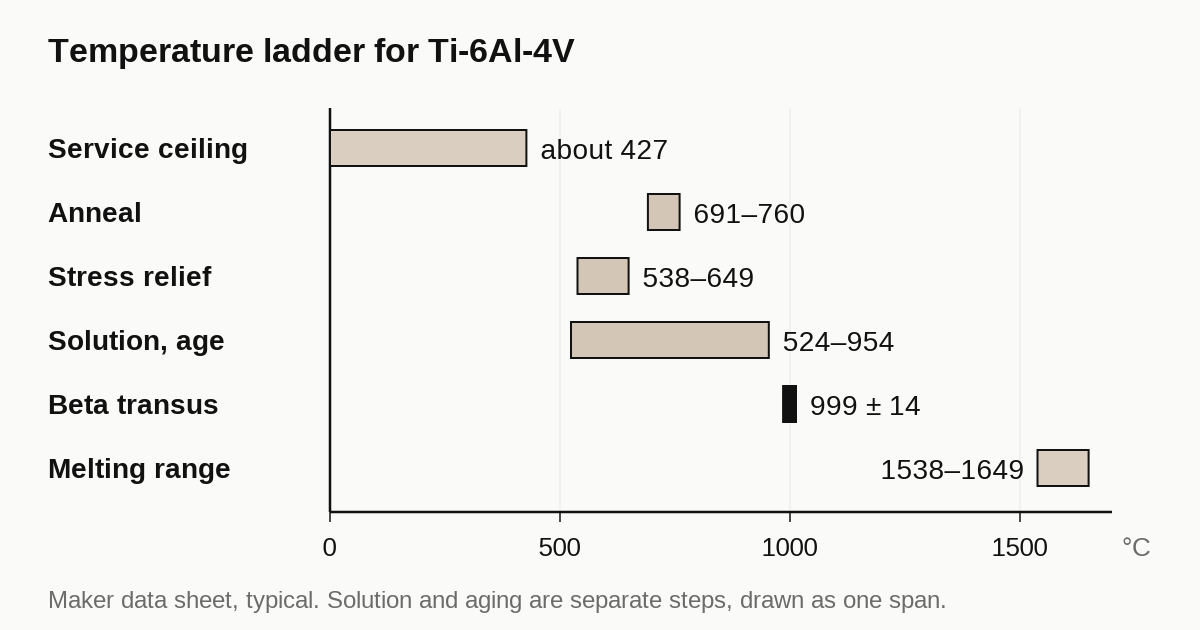
Pure titanium melts at 1668 °C (3034 °F). Alloys melt over a range, and the figure depends on whose datasheet you read: ATI gives 1538 to 1649 °C for Ti-6Al-4V and United Performance Metals gives a liquidus of 1650 to 1660 °C for the ELI version. None of these numbers is a limit a machined part ever approaches, and none is the number a machinist works to.
This guide lists the values we read in October 2026, then explains the temperatures that matter for machining titanium: the beta transus, the service ceiling and the point where chips can burn.
Melting point and beta transus by grade
Melting is the top of the temperature ladder. The beta transus is lower and matters more to anyone heat treating or forging, because above it the alpha phase turns into beta.
| Material | Melting, °C | Melting, °F | Beta transus, °C | Source |
|---|---|---|---|---|
| Pure titanium (element) | 1668 | 3034 | 882 | Wikipedia |
| CP Grades 1 to 4 | 1649 to 1671 | 3000 to 3040 | 888 (Gr 1) to 949 (Gr 4), ± 4 | ATI |
| Ti-6Al-4V, Grade 5 | 1538 to 1649 | 2800 to 3000 | 999 ± 14 | ATI |
| Ti-6Al-4V ELI | 1650 to 1660 (liquidus) | 3000 to 3020 | 966 ± 14 | United Performance Metals |
Source: the datasheets and pages listed under Sources, read October 2026. Datasheet values are typical, not guaranteed minimums or maximums, as ATI states on its sheets. The two Ti-6Al-4V rows come from different mills and define the range differently, so do not mix them in one calculation.
We did not open NIST or a CRC handbook table for the element, so the 1668 °C figure is Wikipedia’s. It sits inside the ATI range for commercially pure grades.
Why alloys melt over a range
An alloy is a mixture, so it does not have to turn liquid at one temperature. The datasheets above show it: the commercially pure sheet gives a range of about 22 °C, the Ti-6Al-4V sheet a range of about 111 °C. A mill that melts titanium works in a vacuum with an electric arc, as set out in our guide to the Kroll process. It is the mill that needs the melting range. A buyer needs the beta transus and the service temperature.
The temperatures that matter in the shop
ATI’s Ti-6Al-4V sheet gives a working ladder in the units a heat treater uses:
- Service ceiling: usable from cryogenic temperatures to about 800 °F (427 °C).
- Anneal: 1,275 to 1,400 °F (691 to 760 °C), half an hour to 2 hours, then air or furnace cool.
- Stress relief: 1,000 to 1,200 °F (538 to 649 °C), 1 to 8 hours.
- Solution treatment: 1,675 to 1,750 °F (913 to 954 °C), 1 hour, water quench.
- Aging: 975 to 1,025 °F (524 to 552 °C), 4 to 8 hours.
- Beta transus: 999 ± 14 °C, above all of the above.
Every heat treatment sits below the beta transus, and the beta transus sits far below melting. Our reference page on the beta transus explains why a certificate line may state it.
Need a quote for this part? Get a titanium quote
Machining heat and fire
The sources we opened do not give measured cutting-zone temperatures, so we give none. They do give two relevant facts. United Performance Metals lists a thermal conductivity of 6.6 W/m K at 20 °C for Ti-6Al-4V ELI, a low value, which points to heat staying near the cut instead of spreading into the bar (our reading of the figure, not a measured result). And Wikipedia says titanium burns in normal air at temperatures below its melting point, reacting with oxygen at 1,200 °C in air and at 610 °C in pure oxygen. The chip fire guide covers the shop rules and the sources behind them.
Heat also leaves a mark on the surface. Rolled Alloys describes a brittle, oxygen-contaminated surface layer, alpha case, that can form when titanium is heat treated without a high vacuum or inert atmosphere, and says it is removed by pickling, chemical milling, blasting or machining.
What to put on the RFQ
Do not write a melting point on a drawing. If heat treatment matters, write the condition and the specification, such as annealed to AMS 4928, and let the shop choose the cycle. If service temperature matters, state the temperature and duration so the shop can check the grade. Send the drawing through the RFQ form and we reply within 24 business hours with one itemised quote, made by a partner shop that cuts titanium.
Back to cutting speed
Melting is irrelevant to feeds and speeds; chip control and coolant are not. Start with our titanium speeds and feeds guide for typical windows, which a shop confirms for your part.
Sources
- Wikipedia, Titanium: melting point 1668 °C, alpha to beta transition 882 °C, burning in air, read 25 October 2026
- ATI, CP Grade 1 to 4 technical data sheet: melting range and beta transus by grade
- ATI, Ti-6Al-4V Grade 5 technical data sheet: melting range, beta transus, heat treatment temperatures, service ceiling
- United Performance Metals, Ti-6Al-4V ELI datasheet: liquidus, beta transus, thermal conductivity
- Rolled Alloys, How titanium sponge and scrap become final products: alpha case and its removal
Frequently asked questions
What is the melting point of titanium?
Pure titanium melts at 1668 °C (3034 °F). Commercially pure grades are quoted at 1649 to 1671 °C and Ti-6Al-4V at 1538 to 1649 °C on one mill datasheet, 1650 to 1660 °C liquidus on another. Alloys melt over a range, and each datasheet defines its own range, so read the one for your mill.
Is the melting point the temperature limit for a titanium part?
No. ATI states Ti-6Al-4V is usable from cryogenic temperatures to about 427 °C (800 °F). Strength, oxidation and the beta transus, near 999 °C for this alloy, matter long before melting. The melting range matters to the mill that melts and casts the ingot, not to the part designer.
Can titanium catch fire while it is machined?
Yes, under some conditions. Wikipedia notes that titanium burns in normal air at temperatures below its melting point, which is why melting itself needs a vacuum or inert atmosphere. Our chip fire guide sets out the shop rules for fines, coolant and chip handling and what each source supports.
Need a quote for this part?
Send the drawing. We send one itemised quote for the finished parts and reply within 24 business hours.
Get a titanium quote