Guides / Finishing
The Titanium Oxide Film: Why Titanium Resists Corrosion and Re-forms
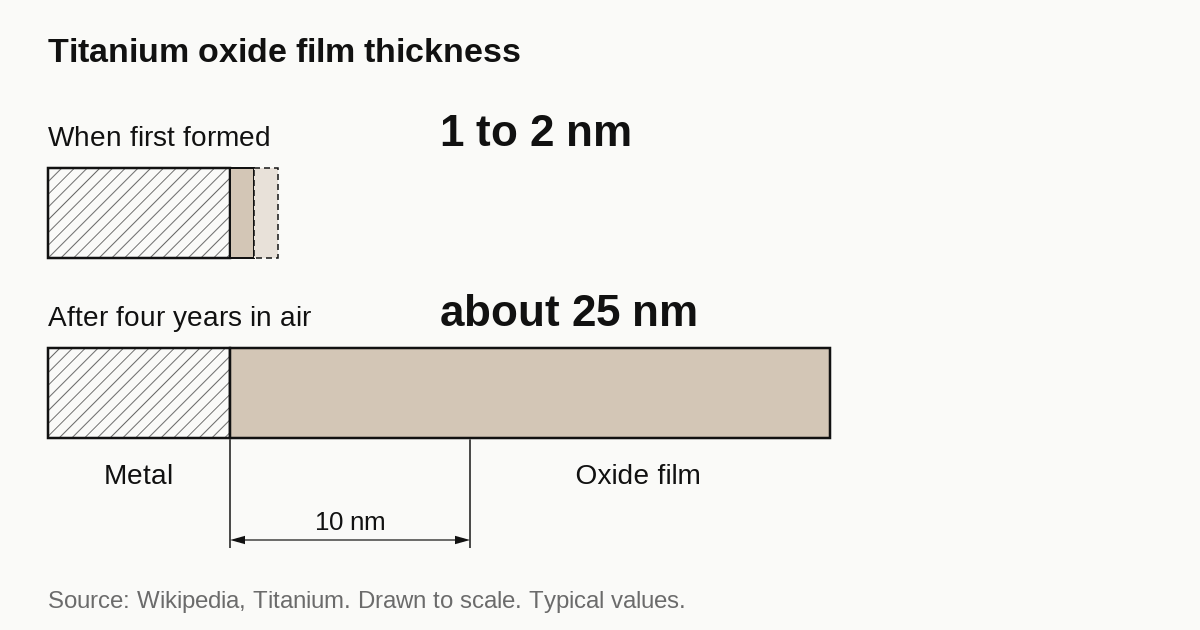
Titanium resists corrosion because it is covered by a very thin film of titanium oxide that forms the moment clean metal meets air. Wikipedia describes the film as non-porous, 1 to 2 nm thick when first formed and about 25 nm after four years in air. The film is why titanium is used in seawater and chemical service, and its limits are why a few chemicals and some machining practices still attack it.
A thicker oxide made on purpose is covered in our titanium anodizing guide. This guide sets out what the film is, where it holds, where it fails and what a buyer of machined parts should write on the drawing. Facts were read in October 2026. It is a buyer’s summary, not a corrosion handbook: we did not open the ASM corrosion volume or a mill corrosion guide, and corrosion service should be checked against one.
What the film is
The surface of titanium oxidises immediately on exposure to air, forming a thin passive layer. Wikipedia gives the thickness as 1 to 2 nm when first formed, growing to about 25 nm after four years. For scale, 25 nm is 0.025 µm. A separate Wikipedia article on passivation says the layer makes titanium suitable for corrosive environments such as seawater.
United Performance Metals describes the film on Ti-6Al-4V as stable and tightly adherent, giving excellent resistance to general corrosion in many aqueous environments, including seawater, oxidizing acids, wet chlorides and alkaline solutions.
Where the film holds and where it fails
| Environment | What the source says | Source |
|---|---|---|
| Seawater, wet chlorides, alkaline solutions, oxidizing acids | Excellent general corrosion resistance | United Performance Metals |
| Strongly reducing acids | Alloy can be attacked | United Performance Metals |
| Dilute hydrofluoric acid, hot hydrochloric acid, hot sulfuric acid | Film dissolves | Wikipedia |
| Chlorine salts on stressed parts later heated | Stress corrosion cracking may occur | United Performance Metals |
| Heat treated in air without high vacuum or inert gas | Brittle oxygen-rich layer (alpha case) forms | Rolled Alloys |
Source: the pages under Sources, read October 2026. These are qualitative statements without concentrations or temperatures, so they screen an application and do not qualify it. For a real service condition, ask the shop or the mill for corrosion data on the exact grade and conditions.
The last row is a different story from the natural film. Alpha case is a thick, brittle layer that forms at high temperature, and Rolled Alloys says it is removed by pickling, chemical milling, blasting or machining, as we explain in our guide to pickling and chemical milling.
What machining does to the film
A cut exposes fresh metal, and the Wikipedia article says the surface oxidises immediately in air, so the film re-forms. That is the basis of the word “heals”. What the film cannot do is remove contamination left in the surface. ASTM F86, the practice for surgical implants, states its purpose as improving corrosion resistance of implant surfaces, covers passivation among other treatments, and says particles from forming, machining or marking should be removed to limit localised corrosion. That standard is written for implants, not for general parts, but the principle is what a corrosion-critical drawing asks for. Our reference page on cleaning and passivation to ASTM F86 lists what it does and does not cover.
ASTM B600 is a guide for descaling and cleaning titanium surfaces by blasting and acid pickling, as our ASTM B600 page explains. It sets no depth or hydrogen limit, so a drawing that only says “clean per B600” leaves the real requirement unwritten.
Need a quote for this part? Get a titanium quote
Thicker film by anodizing
Wikipedia says titanium can be anodized to produce a thicker passivation layer, and that the thickness directly affects the colour produced through thin-film interference. Anodizing is therefore a way to build the oxide on purpose, for colour, identification or a controlled surface. Our anodizing guide, linked above, covers what to specify.
What to write on the drawing
- Name the cleaning or surface condition you need, with the specification, instead of the word “passivate”.
- State the service environment, such as seawater or a named acid, so the shop can check the grade.
- Say whether parts may contact steel tools or fixtures before cleaning, and whether iron on the surface is acceptable.
- State any colour or anodize requirement as a finish, with its own specification.
If you are unsure how to word these, send the drawing through the RFQ form and we reply within 24 business hours with one itemised quote, made by a partner shop that cuts titanium.
Next step in finishing
For colour, wear and surface options after machining, start with the titanium anodizing guide and then the pickling guide linked above.
Sources
- Wikipedia, Titanium: thin non-porous film, 1 to 2 nm growing to about 25 nm after four years, dissolves in HF, hot HCl and hot H2SO4, read 25 October 2026
- Wikipedia, Passivation (chemistry): titanium oxide layer, seawater, anodizing and colour, read 25 October 2026
- United Performance Metals, Ti-6Al-4V Grade 5 datasheet: passive oxide film, environments and limits
- ASTM F86-21, Standard Practice for Surface Preparation and Marking of Metallic Surgical Implants: scope and purpose
- ASTM B600-22, Standard Guide for Descaling and Cleaning Titanium and Titanium Alloy Surfaces
- Rolled Alloys, How titanium sponge and scrap become final products: alpha case and its removal
Frequently asked questions
What is the oxide film on titanium?
It is a thin, non-porous layer of titanium oxide that forms on the surface almost immediately when metal meets air. Wikipedia gives its thickness as 1 to 2 nm when first formed and about 25 nm after four years. The film is what gives titanium its resistance to seawater and many chemicals.
Does the oxide film grow back after a scratch or a cut?
In air, fresh titanium oxidises immediately, so a cut surface forms a new film at once. That does not mean any damage is harmless. Embedded particles and smeared metal from machining can still start local corrosion, which is why cleaning and passivation standards ask for them to be removed.
Is the oxide film the same as anodizing?
No. The natural film is a few nanometres thick and forms by itself. Anodizing builds a thicker oxide by passing current, and the thickness sets the interference colour. Anodizing is a controlled finishing process with its own specification, so state it on the drawing if you need it.
Need a quote for this part?
Send the drawing. We send one itemised quote for the finished parts and reply within 24 business hours.
Get a titanium quote