Guides / Grades
Titanium Aluminide: What It Is, Where It Is Used and What Machining Needs
Titanium aluminide is an intermetallic compound of titanium and aluminium that is lighter than most high-temperature metals and holds its strength where ordinary titanium alloys stop. It is also brittle: NASA describes TiAl-based materials as difficult to fabricate because of their inherent low ductility. For a buyer that means a different material class, not a harder grade of Ti-6Al-4V, and a shop should show experience with it before you accept a quote.
This guide covers what it is, where it is used and what to ask. It is written for readers choosing among titanium grades and who have met “TiAl” on a drawing. Facts were read in October 2026. We found no open source with machining parameters for TiAl, so there are none here.
Three compounds, one family
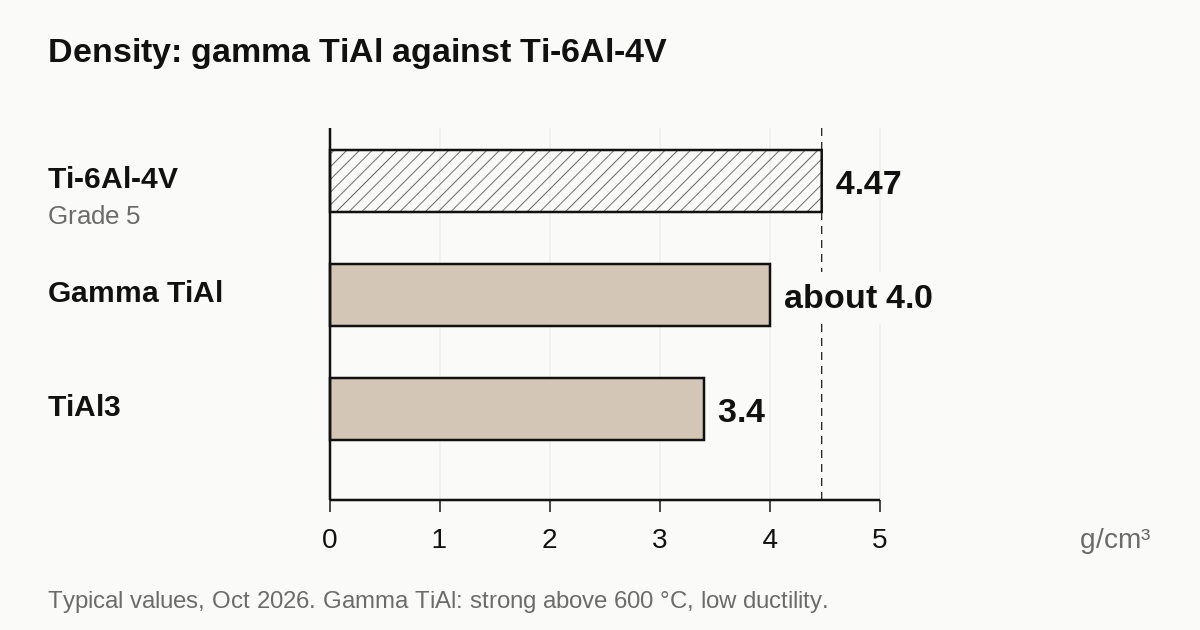
Wikipedia lists three main titanium aluminide intermetallics: gamma TiAl, alpha-2 Ti3Al and TiAl3. Gamma TiAl has received the most interest and applications. Its density is about 4.0 g/cm³ (0.14 lb/in³), and Wikipedia notes that nickel superalloys are nearly twice as dense. TiAl3 is lighter still at 3.4 g/cm³ (0.12 lb/in³), but it has poor ductility and Wikipedia says its machining quality is still difficult, with near-net-shape manufacturing considered one of the best options.
| Material | Density, g/cm³ | Density, lb/in³ | Temperature note | Source |
|---|---|---|---|---|
| Ti-6Al-4V, Grade 5 | 4.47 | 0.160 | usable to about 427 °C (800 °F) | ATI |
| Gamma TiAl | about 4.0 | 0.14 | strength and oxidation resistance above 600 °C, some alloys to 1000 °C | Wikipedia |
| TiAl3 | 3.4 | 0.12 | best oxidation resistance, flagged on the page as needing comparison | Wikipedia |
Source: the pages under Sources, read October 2026. The figures are typical. Alpha-2 Ti3Al is not in the table because the page we read gives no density for it. Wikipedia’s 1000 °C figure is for some gamma alloys and not a design limit.
Reading a TiAl designation
TiAl names do not follow the grade-number habit of commercial titanium. The NASA abstract for one gamma alloy gives its nominal composition as Ti-46.5Al-4(Cr,Nb,Ta,B) in atomic percent, and a third-generation alloy is called Gamma Met PX. Atomic percent is not weight percent, so a drawing that says “Ti-48Al” needs the basis and the supplier’s alloy name before anyone quotes. Ask for the specification or the producer’s data sheet, not only the shorthand.
Where the temperature range matters
NASA’s Lewis Research Center (now Glenn) work describes titanium aluminides as attractive alternatives to superalloys in moderate temperature applications, 600 to 850 °C, because of high strength relative to density. The same NASA summary warns that most titanium-based alloys degrade through interstitial embrittlement and rapid oxidation at elevated temperature, so the environment has to be studied before use. Third-generation gamma alloys, such as the Nb-rich Gamma Met PX that NASA tested, were developed for higher temperature capability with low density and high stiffness.
For comparison, our guide to high-temperature titanium alloys such as Ti-6242 covers conventional alloys built for higher temperatures.
Where it is used
Wikipedia says General Electric uses gamma TiAl for the low-pressure turbine blades of its GEnx engine, which powers the Boeing 787 and 747-8, from 2011, the first large-scale use on a commercial jet engine. The blades are cast, and the same page says additive manufacturing is being explored as an alternative route. NASA’s reports cover hypersonic and launch vehicle structures. In other words, TiAl is a specialist material for hot rotating or high-speed parts, not a general machining stock.
Aerospace engine parts can carry export controls. Classify the finished part and its drawing before it leaves your control, as set out in our titanium export control guide. This guide is civil in framing and is not legal advice.
Need a quote for this part? Get a titanium quote
What machining it involves
Here the open evidence is thin, and we say so. The sources give three relevant facts: low ductility makes TiAl materials difficult to fabricate (NASA), TiAl3 machining quality is described as difficult and near-net-shape methods are preferred (Wikipedia), and the GEnx blades are cast before being machined. From low ductility one can infer a brittle material that is intolerant of shock and chatter, but that is our reading, not a measured machining result.
Questions to ask a shop:
- Which TiAl alloy has it cut before, and for which kind of part?
- Does it cut from cast near-net blanks, wrought stock or an additive blank?
- Which inspection does it use for cracks after machining, and who writes the acceptance limits?
- Is the blank supplier named, with a heat or lot record?
How to quote it
State the exact alloy, not “TiAl”, the blank form, the acceptance criteria and the export classification. Expect fewer shops to respond than for Ti-6Al-4V. Send the drawing through the RFQ form and we reply within 24 business hours with one itemised quote, made by a partner shop that cuts titanium.
Back to grade choice
If your service temperature is within the range ATI gives for Ti-6Al-4V, about 427 °C, check a conventional alloy first. The titanium grade selection guide sets out how to choose among the grades shops cut every day.
Sources
- Wikipedia, Titanium aluminide: compounds, density, temperature capability, GEnx blades, TiAl3 machining, read 25 October 2026
- NASA NTRS, Cost-Effective TiAl based Materials: low ductility and difficult fabrication
- NASA NTRS, Evaluation of a Gamma Titanium Aluminide for Hypersonic Structural Applications: nominal composition in atomic percent
- NASA NTRS, Environmental Studies on Titanium Aluminide Alloys: 600 to 850 °C, embrittlement and oxidation
- NASA NTRS, Third-Generation TiAl Alloy Tested: Gamma Met PX for rotating components
- ATI, Ti-6Al-4V Grade 5 technical data sheet: density and service ceiling
Frequently asked questions
What is titanium aluminide?
It is an intermetallic compound of titanium and aluminium, not a conventional titanium alloy. The three main ones are gamma TiAl, alpha-2 Ti3Al and TiAl3. Gamma TiAl has seen the most use. It is about 4.0 g/cm³ and keeps strength and oxidation resistance above 600 °C, but it has low ductility.
Is titanium aluminide the same as Ti-6Al-4V?
No. Ti-6Al-4V is an alpha-beta titanium alloy, usable to about 427 °C according to ATI, and it is ductile enough to forge, roll and machine in routine ways. Gamma titanium aluminide is an intermetallic compound that works at higher temperatures and is brittle by comparison. Do not substitute one for the other.
Can any machine shop cut titanium aluminide?
We found no open source that gives safe cutting data for it, so we cannot name parameters. NASA describes TiAl materials as difficult to fabricate because of low ductility. Ask a shop for prior parts in this material, the tooling it used and whether it cuts from cast near-net blanks or wrought stock.
Need a quote for this part?
Send the drawing. We send one itemised quote for the finished parts and reply within 24 business hours.
Get a titanium quote