Home / Specifications / AMS 4911: Ti-6Al-4V Sheet, Strip and Plate, Annealed
AMS 4911: Ti-6Al-4V Sheet, Strip and Plate, Annealed
AMS 4911 is the SAE aerospace material specification for Ti-6Al-4V in the annealed condition as sheet, strip and plate up to 4.000 inches thick; it asks more of the mill than the commercial ASTM B265 standard, so “Ti-6Al-4V plate per AMS 4911” on a drawing means a specific pool of certified flat stock, not any Grade 5 plate.
Key facts
| Item | AMS 4911 |
|---|---|
| Issued by | SAE International, Aerospace Material Specification, AMS G Titanium and Refractory Metals Committee |
| First issued | July 1957 |
| Newest revision listed by SAE | T, November 2025 (as of October 2026) |
| Revisions seen on drawings | N (2014), P (2018), R (2019), S (2024), T (2025) |
| Alloy | Ti-6Al-4V |
| Condition | Annealed |
| Product forms | Sheet, strip and plate |
| Thickness covered | Up to and including 4.000 in (101.60 mm) |
| Bar equivalent | AMS 4928 annealed, AMS 4965 solution treated and aged |
| Commercial equivalent | ASTM B265 Grade 5 |
Scope and revision data are from SAE’s listing. SAE shows no revision beyond T. The text of the specification, including its limits and test frequencies, is in the purchased document; this page summarises what it covers and does not reproduce it.
Aerospace flat product, and who asks for it
AMS specifications are written by industry committees for aerospace users. AMS 4911 is the Ti-6Al-4V flat product document that airframe and engine drawings name for brackets, fittings, panels and machined structural parts cut from plate. Other industries rarely name it, because B265 Grade 5 is enough for most industrial work.
A drawing may name AMS 4911 directly, name it through a customer material specification or call it “or equivalent”. The last wording is the one that needs a decision from the drawing owner: whether B265 Grade 5 counts as equivalent. The shop does not decide that.
Export controls can apply to aerospace drawings. The material may be ordinary, the drawing may not be. Classification stays with the buyer and the shop, and the export controls guide explains why the drawing is the controlled item. This is not legal advice: confirm with your export compliance officer.
AMS 4911 against its neighbours
| Document | Alloy and condition | Forms | Use |
|---|---|---|---|
| AMS 4911 | Ti-6Al-4V, annealed | Sheet, strip, plate | Aerospace flat product |
| ASTM B265 Grade 5 | Ti-6Al-4V, annealed | Strip, sheet, plate | Commercial flat product |
| AMS 4928 | Ti-6Al-4V, annealed | Bars, wire, forgings, rings, drawn shapes | Aerospace bar |
| AMS 4965 | Ti-6Al-4V, solution treated and aged | Bars, wire, forgings, rings | Aerospace bar, higher strength |
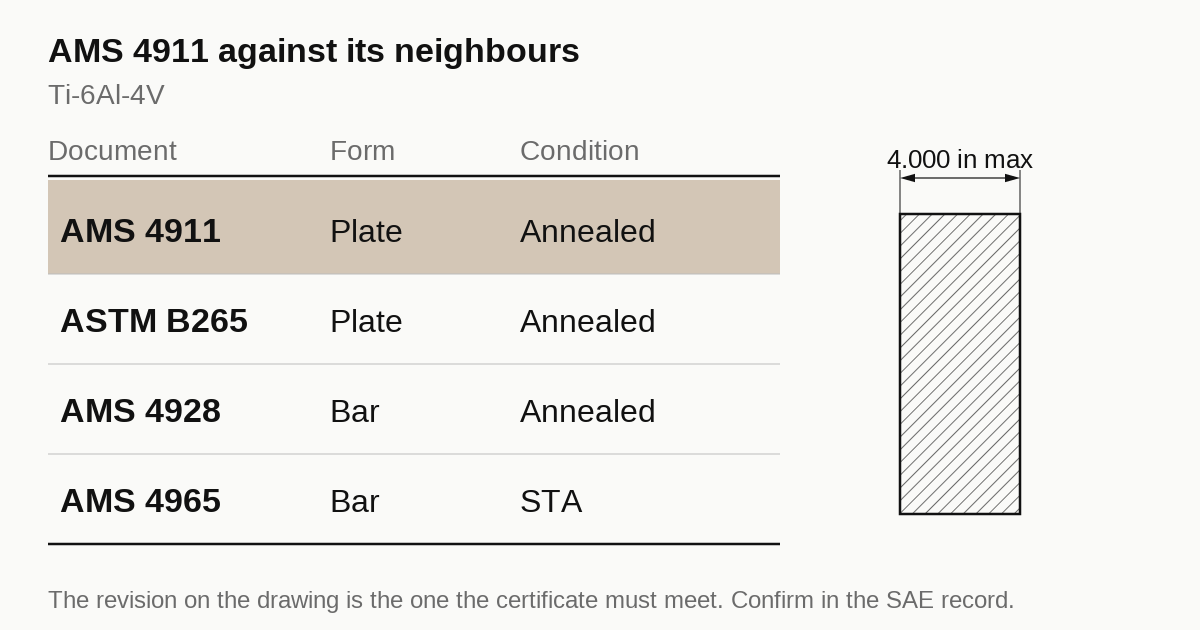
The AMS 4928 page compares the bar specification with the commercial bar standard line by line, and the ASTM B265 page covers the commercial flat product standard. The same pattern holds in both: same alloy window, tighter requirements on the mill, more records.
What the specification controls
An aerospace material specification is a contract between the buyer and the mill. In broad terms AMS 4911 covers the same areas as the aerospace bar specification, applied to flat product.
| Area | What AMS 4911 sets, in outline |
|---|---|
| Chemistry | Heat analysis limits for the alloying and residual elements, including hydrogen, oxygen and nitrogen |
| Melting | Permitted melting practice for the ingot |
| Condition | Annealed, with the anneal stated |
| Mechanical properties | Tensile, yield and elongation minimums, tied to thickness |
| Microstructure | Criteria for the worked structure |
| Surface | Delivered free of surface contamination such as alpha case |
| Quality | Freedom from defects, with inspection where the specification or order requires it |
| Reports | Certified results and the specification revision on the report |
The detailed numbers are in the purchased document. The hydrogen, oxygen and nitrogen page explains the interstitial elements that every certificate for Ti-6Al-4V shows, and the tensile test report page explains how to read the mechanical results.
The revision letter
SAE issues AMS specifications with a revision letter that changes when the text changes. AMS 4911 has had many: the record lists revisions from A in 1963 through T in November 2025. A drawing may name a letter that is years old, and mills certify to the revision on the purchase order.
| Situation | What to do |
|---|---|
| Drawing names no revision | The shop buys to the current one. Ask your customer if that is acceptable |
| Drawing names revision P or R | Buy to that letter, or get written approval to use T |
| Drawing names “latest revision” | Name the revision on the PO so the certificate shows it |
| Certificate shows a newer letter than the drawing | Hold the lot until the drawing owner approves in writing |
The drawing owner decides whether a newer letter is acceptable. The shop never swaps a revision on its own.
Thickness, heat treatment and machining
The scope runs from thin sheet up to plate 4.000 in (101.60 mm) thick. Annealed plate is the condition most shops machine, and the titanium speeds and feeds guide uses annealed Ti-6Al-4V as its baseline.
If the part needs a higher strength than annealed plate gives, the drawing adds a heat treatment after machining. AMS 2801 covers heat treatment of titanium alloy parts, and SAE lists revision D of March 2024 as the newest. The solution treated and aged guide explains the sequence. A part cut from AMS 4911 plate and heat treated later is not the same material record as bar bought to AMS 4965, and the drawing must say which route it expects.
Source approval and the certificate
Many aerospace customers add a layer above AMS 4911: approved mills, approved stockists and flow down clauses on the purchase order. Conformance to AMS 4911 alone does not satisfy an approved source requirement. The approved mill sources page explains how those lists work.
A certificate against AMS 4911 should show:
- The specification number and revision.
- The heat number, matching the plate marking.
- Chemistry results for the listed elements, including hydrogen.
- Tensile results with the thickness and test direction.
- Any microstructure or inspection results the order requires.
- The mill and the signature or stamp releasing the heat.
The mill certificate guide covers how a shop checks those lines.
How to call out AMS 4911
| Callout | Complete? | What the shop will do |
|---|---|---|
| “Titanium plate” | No | Ask, and lose a day |
| “Grade 5 plate” | No | Buy B265 plate |
| “Ti-6Al-4V per AMS 4911” | Partly | Buy to the current revision, which may not be the one your customer approved |
| “Ti-6Al-4V plate per AMS 4911 rev R, annealed” | Yes | Buy certified plate to that revision |
| “Ti-6Al-4V per AMS 4911 or ASTM B265” | Ambiguous | Ask which one governs |
What to write on the RFQ
- Material line: Ti-6Al-4V per AMS 4911, revision letter, annealed.
- Form and size: plate thickness and the blank size the shop buys.
- Companion specs: inspection and heat treatment specifications on the drawing.
- Approved sources: any mill or stockist list your customer imposes.
- Certificates: mill certificate showing the specification and revision, plus a certificate of conformity naming the heat.
- Substitution: whether B265 Grade 5 or a newer revision is acceptable, and who approved it.
We hold no certificates. We quote your drawing with partner shops that buy to AMS specifications; ask us for the shop’s approvals and check them with the issuing body. Send the drawing through the RFQ form and shops reply within 24 business hours. Other numbers are on the specification index.
Frequently asked questions
What does AMS 4911 cover?
AMS 4911 is the SAE Aerospace Material Specification for Ti-6Al-4V in the annealed condition, supplied as sheet, strip and plate. SAE lists the scope as up to and including 4.000 inches (101.60 mm) in thickness.
What is the current revision of AMS 4911?
SAE lists revision T, dated November 2025, as the newest as of October 2026. It replaced revision S of August 2024. Earlier letters still appear on drawings, including R of December 2019, P of February 2018 and N of March 2014.
Is AMS 4911 the same as ASTM B265 Grade 5?
It is the same alloy under a different document. B265 Grade 5 is the commercial standard. AMS 4911 is the aerospace specification and carries its own requirements for the mill. B265 Grade 5 plate is not AMS 4911 plate unless the certificate shows both.
Which AMS spec covers Ti-6Al-4V bar?
AMS 4928 covers annealed Ti-6Al-4V bars, wire, forgings and rings. AMS 4965 covers the same forms solution treated and aged. A part machined from bar takes the bar specification, and a part machined from plate takes AMS 4911.
Sources
- SAE AMS 4911T (November 2025), Titanium Alloy, Sheet, Strip, and Plate, 6Al-4V, Annealed: scope and revision history
- ASTM B265-25, Standard Specification for Titanium and Titanium Alloy Strip, Sheet, and Plate
- SAE AMS 4965N (August 2022), Ti-6Al-4V solution heat treated and aged bars, wire, forgings and rings
- SAE AMS 2801D (March 2024), Heat Treatment of Titanium Alloy Parts
Last reviewed November 27, 2026. Figures are typical values from the standards and handbooks named above. The standard on your drawing and the mill certificate for your heat govern.
Need a quote for this part?
Send the drawing with the grade and specification lines. We send one itemised quote for the finished parts and reply within 24 business hours.
Get a titanium quote