Guides / For Shops
TPM for Titanium Machining Centers: Spindle, High-Pressure Coolant and Chip Handling
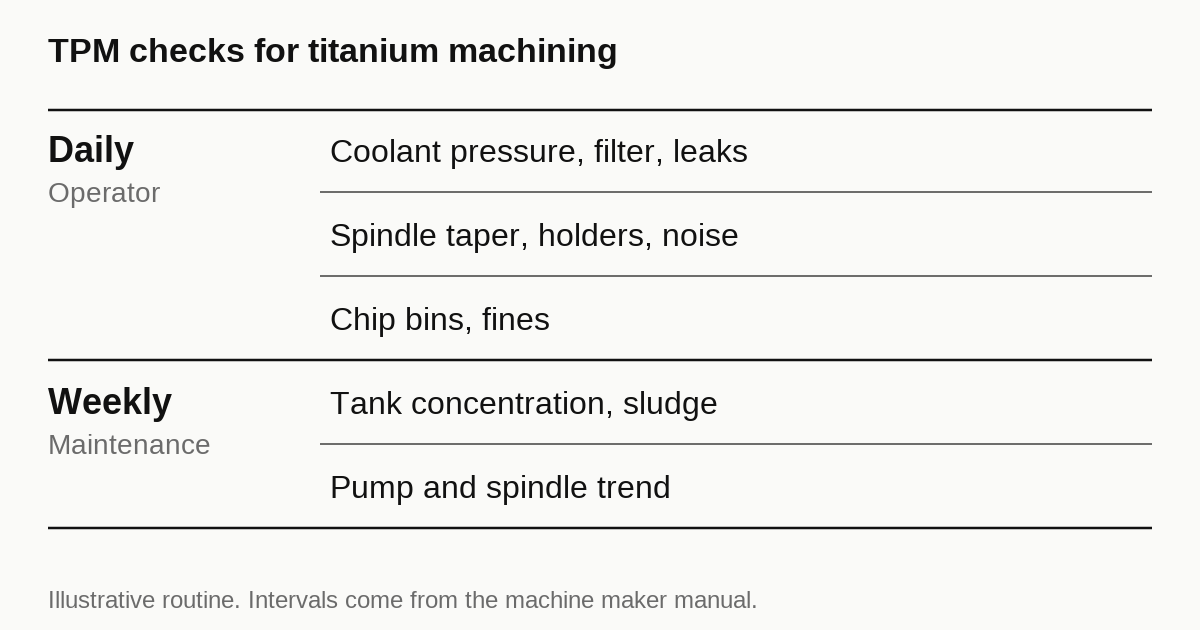
Total productive maintenance for a titanium machining center starts with the systems titanium stresses first: the high-pressure coolant circuit, the spindle and its tool holders, and the chip and fines handling. Run a daily operator check and a weekly maintenance check on one machine, log every stop and use the log to decide what to fix. That is most of a first TPM program for a small shop.
We own no machines, so this is a routine for you to adapt to your maker’s manual, not a service we provide. The fire rules for chips are in our post on titanium chip fire safety and are not repeated here.
Why titanium work hits coolant and chip systems first
Titanium is cut at low surface speed, with coolant doing a great deal of the work. A published turning study of Ti-6Al-4V ELI used 70 bar coolant at cutting speeds of 40 to 80 m/min. A University of Sheffield paper reports that, for a 15-minute tool life, flood coolant allowed 88 to 92 percent of the speed possible with through-tool coolant, against 70 to 80 percent for dry turning. The coolant system is a production tool here, not an accessory. When pressure drops, a filter loads or a nozzle drifts, the first symptom is tool wear or a poor chip, long before an alarm.
Chips are the other load. Titanium makes long ribbons or fine swarf depending on the cut, and they clog conveyors, filters and sumps. The same Sheffield paper states that the ignition of dry titanium chips can cause a fire, so chip handling is a maintenance question and a safety question together.
What TPM is, in a few lines
A general reference describes TPM as focused on maintaining and improving manufacturing machinery, spreading responsibility for maintenance and machine performance across the organisation. Seiichi Nakajima developed it in Japan, and the Japan Institute of Plant Maintenance later expanded it to eight activities: autonomous maintenance, focused improvement, planned maintenance, quality maintenance, early equipment management, education and training, office TPM, and safety, health and environment. We use the first and third here. Its main objective is to raise overall equipment effectiveness, OEE, which is the product of availability, performance and quality.
Autonomous maintenance: daily operator checks
In autonomous maintenance (jishu hozen in Japanese, meaning care of the machine by the person who runs it), operators use their senses to help find the causes of losses. For a titanium machining center that means a short, written check at the start of every shift, covering four things:
- High-pressure coolant: the pressure at the gauge, the filter indicator, leaks and nozzle aim.
- Spindle and holders: taper and holders wiped clean, and the sound and heat of the spindle at start-up.
- Chips and fines: bins emptied and closed, nothing left to pile up on the machine.
- Coolant condition: level, smell and any visible tramp oil.
Keep it to what an operator can do in five minutes without tools. If a check needs a spanner or a measurement, it belongs to maintenance.
Planned maintenance: filters, pumps, spindle checks
Planned maintenance is the work trained maintenance staff do on a schedule, based on the machine maker’s manual and your own breakdown record. The table below gives the full daily, weekly and monthly routine to adapt.
| When | System | Check | Who |
|---|---|---|---|
| Daily | High-pressure coolant | Pressure at the gauge, filter indicator, leaks, nozzle aim | Operator |
| Daily | Spindle and holders | Taper and holders wiped clean, sound and heat at start-up | Operator |
| Daily | Chips and fines | Bins emptied and closed, fines not left on the machine or floor | Operator |
| Daily | Coolant | Level, smell, visible tramp oil | Operator |
| Weekly | Coolant tank | Concentration, sludge, temperature | Maintenance |
| Weekly | Filters | Element condition against the maker’s guide | Maintenance |
| Weekly | Pump and spindle | Pump sound and current against a baseline, spindle log entry | Maintenance |
| Monthly | Chip conveyor | Guards, drive, chain or belt wear | Maintenance |
Intervals come from the maker’s manual and your record, not from this table. The right interval for a filter is the one your own pressure log supports.
Chip and fines handling as a maintenance and fire issue
The housekeeping rules for fines belong to your fire authority and your safety data sheets. For maintenance, three points help.
- Treat the chip conveyor, the sump and the filter as parts of the machine with a schedule, not as bins that get emptied when they are full.
- Keep fines out of places where they pile up: ledges, the control cabinet area and the base of the machine.
- Know which standard governs combustible metals at your site. NFPA 484 is the US standard for combustible metals, and an OSHA letter of interpretation from 2016 discusses its 2015 edition, which among other provisions does not permit certain dry collectors for aluminium dust. That letter does not mention titanium, so ask your fire authority which edition and rules apply to titanium fines in your plant.
Need a quote for this part? Get a titanium quote
Tracking breakdowns and short stops
Start a log on the first day. A general reference on OEE separates breakdowns and waiting, which reduce availability, from minor stops and reduced speed, which reduce performance. Companies commonly set a recording limit for minor stops of one to five minutes, according to that reference. Pick a limit that your operators will actually write down.
Copy this table.
| Date | Machine | Stop minutes | System | Symptom | Cause | Fix | Check added |
|---|---|---|---|---|---|---|---|
| 2026-11-03 | VMC-2 | 35 | HP coolant | Pressure drop in cut | Filter loaded | Element changed | Filter indicator on daily check |
| 2026-11-05 | VMC-2 | 4 | Chips | Conveyor jam | Long chip ribbon | Cleared | Chip breaking review |
| 2026-11-06 | VMC-2 | 90 | Spindle | Alarm at start-up | Chip packed in taper | Taper cleaned | Wipe step on daily check |
The rows are an example, not data from any shop. The last column is the point: every stop should add or sharpen a check, or you have only a list of problems.
Starting TPM on one machine
- Pick the machine that cuts the most titanium or stops most often.
- Clean it fully once, with the operator, and write down every leak, loose guard and hard-to-reach spot you find. That is the first step of autonomous maintenance.
- Put the daily checklist on the machine and have the operator initial it.
- Start the stop log.
- Review the log weekly for fifteen minutes with operator and maintenance together.
- After a month, change the checklist from what the log shows, then repeat on a second machine.
Do not set an OEE target in the first month. Count stops, find the top cause and remove it.
Talk to us
If your shop cuts titanium and wants to see how shop registration works, talk to us. We send work requests for titanium parts to partner shops that cut the grade in question: the shop quotes us and we place the PO. There is no fee to join and no charge per request. For the tooling side of the same machine, see our guide to titanium tooling and coolant.
Sources
- Wikipedia, Total productive maintenance (origin, eight activities, autonomous maintenance, OEE)
- Wikipedia, Overall equipment effectiveness (availability, performance, quality, minor stops)
- Taylor, Hernandez, Marshall and Broderick, Cutting fluid application for titanium alloys in a finish turning process, University of Sheffield (abstract)
- Struzikiewicz, Investigation of the titanium alloy turning process with Prime A tools under high-pressure cooling conditions, Strojniski vestnik 70, 2024
- OSHA, standard interpretation of 23 May 2016 on NFPA 484 and combustible metal dust
Frequently asked questions
What is TPM in a machine shop?
Total productive maintenance spreads care of the machine across the shop. Operators do routine cleaning, inspection and small adjustments, maintenance staff do the planned work and both record losses so they can be removed. It was developed in Japan, and the Japan Institute of Plant Maintenance later expanded it to eight activities, the first being autonomous maintenance.
Why do coolant and chip systems fail first on titanium work?
Titanium is cut slowly with heavy coolant use, often at high pressure, and it makes long or fine chips that load filters, conveyors and nozzles. A published turning study used 70 bar coolant, and another showed that coolant method changes the speed a tool can run. Pumps, filters and chip handling see the most work per hour.
What should an operator check every day on a titanium machine?
Coolant pressure at the gauge, filter indicator, nozzle aim, leaks, the tool holder tapers, spindle sound at start-up and whether chip bins are emptied and closed. Write down what you find. The record is what lets maintenance see a pattern before the machine stops.
Do I need OEE numbers to start TPM?
No. Start with a breakdown and short-stop log on one machine. OEE is the product of availability, performance and quality, and it is useful later, but a log of stops with a cause already shows where hours go. We give no OEE benchmark because we found no reliable public one for titanium shops.
Need a quote for this part?
Send the drawing. We send one itemised quote for the finished parts and reply within 24 business hours.
Get a titanium quote