Guides / For Shops
Capacity Planning for a Titanium Shop: Spindle Hours, Tool Budget and Bar Lead Time
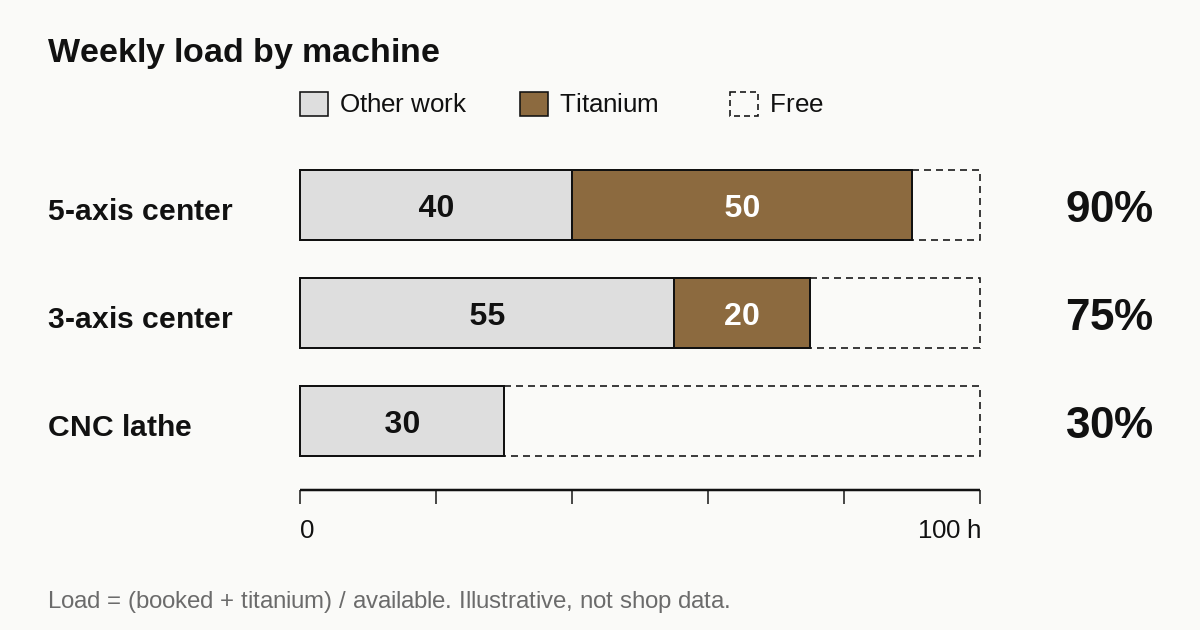
A shop adding titanium work should load its machines with measured titanium cycle times, treat the cutter stock and the bar lead time as limits alongside spindle hours, and review one weekly load chart before it confirms any date. The plan built for steel breaks on titanium for a simple reason: the same part takes longer to cut, uses more cutters and often waits for bar that the shop does not hold.
This post is for shop owners and planners. We own no machines and we do not schedule your floor, so treat the template below as a method you adapt. For the quote side of the same job, see our guide to how to quote titanium work.
Why titanium breaks a steel-based capacity plan
Three things change when a part moves from steel or aluminium to titanium.
Cycle time grows. Titanium alloys are cut at lower surface speeds. A 2024 study of Ti-6Al-4V ELI turning with Sandvik Coromant grade 1115 carbide and 70 bar coolant tested cutting speeds of 40 to 80 m/min. That is a research range for one operation, not a shop standard, and your tool maker’s data governs, but it shows the order of magnitude to expect from a carbide tool in a controlled trial.
Coolant changes the speed you can run. A University of Sheffield paper on finish turning Ti-6Al-4V and Ti-10V-2Fe-3Al reports that, for a 15-minute tool life, dry turning reached 70 to 80 percent of the speed possible with through-tool coolant, and flood coolant reached 88 to 92 percent. The same paper states that the ignition of dry titanium chips can cause a fire. A shop that plans its hours at dry speeds on a machine without through-tool coolant should know why the hours differ.
Material and tools are not on the shelf. A mill order for titanium bar is typically weeks, as our lead time guide lays out, and a special cutter for a deep pocket may also have a lead time. Spindle hours can be free while the job cannot start.
Hours per part from real cycle times
Build every titanium load from three numbers, in this order of preference.
- Measured cycle from the last job on the same machine with a similar part, including tool changes, probing and load and unload.
- CAM cycle from the programming system with the real tool list, plus an allowance for tool changes and measurement that you set from your own records.
- Never a steel cycle multiplied by a round factor.
Add setup once per lot. Then divide: hours for the order = (cycle time per part x quantity) + setup + first article time. If you do not keep cycle data yet, record it on the next three titanium jobs and plan from that. A guess today is still a guess, but a measured number is a guess that improves.
Tool budget as a capacity limit
Cutters are a capacity limit when the cutters you need are not in the building. Write down, for each titanium job:
- the cutters in the program and how many parts one cutter or one edge makes before it comes out, from your own records or a tool trial
- the cutters on hand, on order and the delivery date
- the time a tool change takes, including measurement
Example (illustrative, assumed numbers). A job of 120 Grade 5 brackets. A finishing end mill makes 3 parts before it is changed, so the job uses 40. The shop has 12 on hand and the next delivery is two weeks out. Until the delivery the real capacity for this job is 36 parts, not 120. The planner should either order before confirming the date or confirm a first lot of 36 with a second date for the rest.
Bar lead time and staging
Bar is the third limit. Check it before the machine load, not after.
- Is the bar size on the shelf, at a distributor, or a mill order?
- Does the heat on hand carry the certificate the order requires? Our post on heat lot traceability covers why this matters.
- When the bar arrives, where does it wait and who marks the heat number?
Stage bar to the job: put it in the cell, with its certificate, before the machine slot opens. A slot kept for titanium that waits for bar is lost capacity, because the spindle runs another job while the titanium job waits and the schedule drifts.
Need a quote for this part? Get a titanium quote
A weekly load chart by machine
One page, updated weekly, covering the next four weeks. Copy this template.
| Machine | Available hours | Booked hours (other work) | Titanium hours | Load |
|---|---|---|---|---|
| 5-axis machining center | 100 | 40 | 50 | 90 percent |
| 3-axis vertical center | 100 | 55 | 20 | 75 percent |
| CNC lathe | 100 | 30 | 0 | 30 percent |
Load = (booked hours + titanium hours) / available hours. Available hours are spindle-on hours after planned maintenance, breaks and changeovers, so count what the machine can really cut, not clock hours. The numbers above are an illustration. Overall equipment effectiveness is built from availability, performance and quality, and one common description counts breakdowns, setup, breaks and other stoppages against availability; if you track it, take the available-hours number from there instead of from the clock.
Worked example for Grade 5 brackets. The 120 brackets from above, with an assumed 42 minutes per part (38 minutes of cutting plus 4 minutes of load, unload and measurement) and 6 hours of setup, need 120 x 42 / 60 + 6 = 90 hours. The 5-axis machine has 100 - 40 = 60 hours free in the illustrative week, so it can take 50 hours of brackets and still leave a little. The remaining 40 hours go into the next week. Combine this with the tool limit above and the bar date, and the shop can say: first lot of 36 on this date, balance two weeks later.
Saying no or giving a later date
Review before accepting. A secondary summary of ISO 9001:2015 clause 8.2.3 says the review of requirements is done before the organisation commits to supply, confirms it can meet the requirements and resolves unclear points with the customer. Treat your load chart as the evidence for that review.
When the chart says no:
- Give the earliest date it supports, with the limit named: spindle hours, tools or bar.
- Offer a split lot if the buyer can use one.
- Say what would change the date: bar confirmed at a closer size, a cutter delivery, a buyer decision on a feature.
- Do not confirm a date you cannot support to keep the order. A buyer who is told early can plan; a buyer who is told late cannot.
Our post on first-time titanium jobs covers what to change on the floor before the first run.
Talk to us
If your shop cuts titanium and has spare capacity, see how the shop registration works. We send work requests for titanium parts to partner shops that cut the grade in question: the shop quotes us and we place the PO. There is no fee to join and no charge per request. Talk to us if you want to see a sample work request before you decide.
Sources
- Struzikiewicz, Investigation of the titanium alloy turning process with Prime A tools under high-pressure cooling conditions, Strojniski vestnik 70, 2024
- Taylor, Hernandez, Marshall and Broderick, Cutting fluid application for titanium alloys in a finish turning process, University of Sheffield (abstract; absolute speeds not given)
- The Core Solution, ISO 9001:2015 clause 8.2.3 explained (secondary summary; standard not read)
- Wikipedia, Overall equipment effectiveness (availability, performance, quality)
Frequently asked questions
Why does a steel-based capacity plan fail on titanium work?
Titanium runs at lower surface speeds than steel and aluminium, wears tools faster and needs bar that is often not on the shelf. A plan that counts only machine hours at steel cycle times underloads the spindle, ignores the tool budget and promises a date before the bar is confirmed. Rebuild the hours from a measured titanium cycle.
How many hours should I count per titanium part?
Use the measured cycle from the last similar titanium job, including tool changes, probing and load and unload, plus setup divided over the lot. For a new part, use the CAM cycle plus an allowance for tool changes you set from your own records. Do not scale a steel number by a round factor.
Is the tool budget really a capacity limit?
Yes, when special cutters have a purchase lead time or when tool changes take machine time. A cutter that lasts a few parts means a 100-part order needs a stock of cutters on the shelf before the job starts. If the stock is short, the real capacity is the number of parts the cutters on hand will cut.
How should I answer when I do not have capacity for a titanium order?
Say so early, give the earliest date the load chart supports and name the limit: spindle hours, tools or bar. A later honest date is easier for a buyer to plan around than a confirmed date that slips. If you can take part of the order, offer a split with a date for each lot.
Need a quote for this part?
Send the drawing. We send one itemised quote for the finished parts and reply within 24 business hours.
Get a titanium quote