Guides / Process
Turning Titanium on a Lathe: What Decides Chips, Inserts and Tool Life
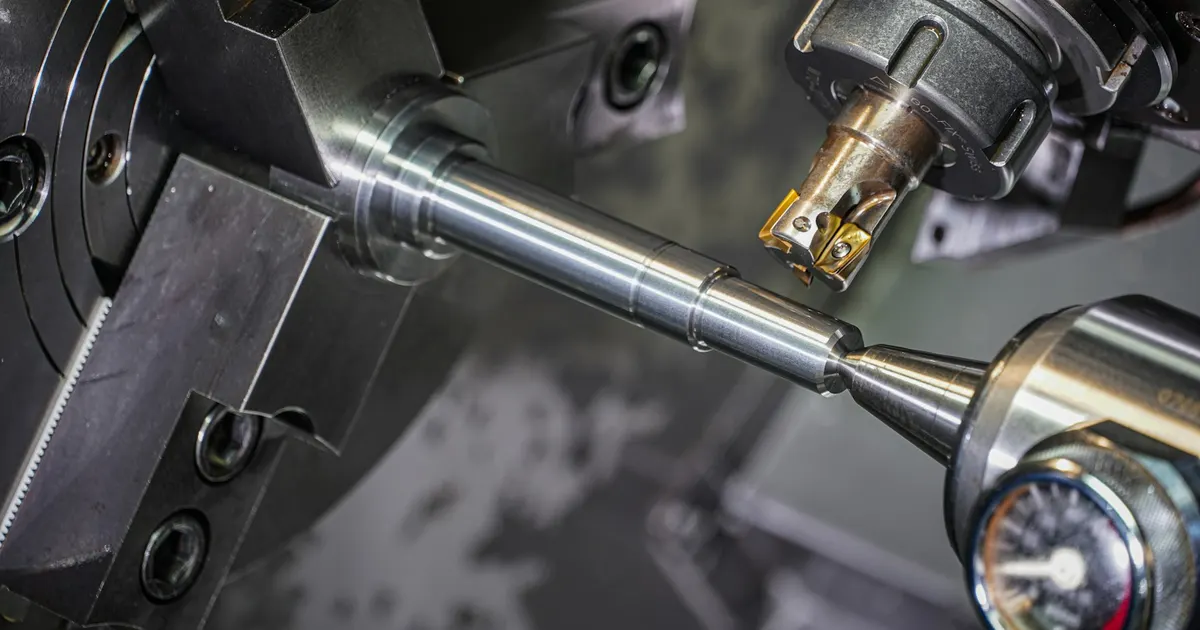
A round titanium part looks like the easy case. No pockets, no thin walls, no five-axis toolpath. Yet turned titanium parts still arrive late and over budget, and the reason is almost always the same: the chip. Titanium forms long, tough, stringy chips that wrap around the workpiece and the tool, scratch finished surfaces and force the operator to stop the machine. Behind the chip sits a second problem, heat that stays at the insert edge instead of leaving with the chip.
This guide explains how shops control both on a lathe, what that does to cycle time and price, and which questions to put on the RFQ for a turned titanium part.
Why titanium turns differently from steel
Titanium conducts heat poorly. Ti-6Al-4V (Grade 5) has a thermal conductivity of roughly 7 W/m·K, against around 16 W/m·K for 316L stainless and well over 100 for aluminium alloys. In steel a large share of the cutting heat leaves with the chip. In titanium most of it stays in a small contact zone on the insert edge, which runs hot at modest cutting speeds.
Two other properties compound this. Titanium is chemically reactive at cutting temperature and tends to weld to the tool material, so the insert loses edge by built-up edge and crater wear instead of clean abrasion. And the chip is ductile, so it does not break the way a steel chip does.
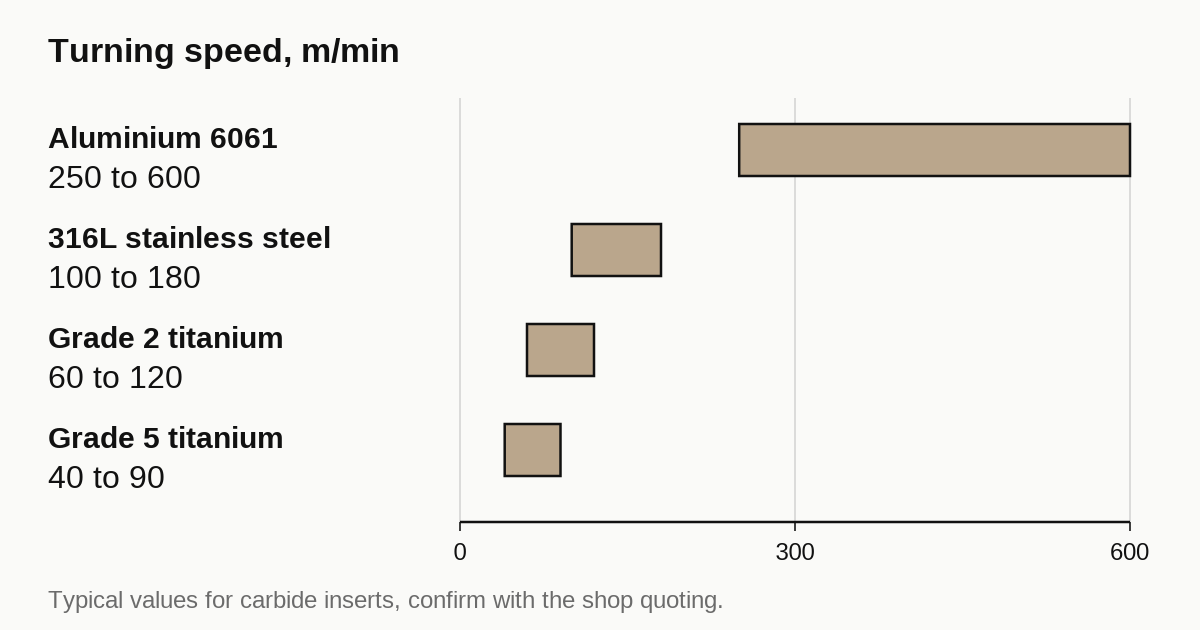
The consequence for the shop is a low cutting speed, a sharp insert, a steady feed and a lot of coolant. For the buyer the consequence is that turning time on titanium is longer than the same part in stainless, and the gap is larger on long, slender or finely finished parts. For general speed ranges across operations see titanium speeds and feeds.
Typical turning parameters
The figures below are typical starting ranges for carbide inserts on Grade 5 with flood or high pressure coolant. Every shop sets its own values by machine, insert and part, and will confirm what it runs for your drawing.
| Operation | Cutting speed | Feed per revolution | Depth of cut |
|---|---|---|---|
| Roughing | around 40 to 60 m/min | 0.15 to 0.30 mm | 2 to 5 mm |
| Semi-finishing | around 50 to 70 m/min | 0.10 to 0.20 mm | 0.5 to 1.5 mm |
| Finishing | around 60 to 90 m/min | 0.05 to 0.15 mm | 0.2 to 0.8 mm |
| Grooving and parting | around 20 to 40 m/min | 0.04 to 0.10 mm | n/a |
Commercially pure grades (Grade 2 especially) can usually run somewhat faster than Grade 5, but they are gummier, so chip control is harder, not easier. Both points are covered in the grade comparison.
Chip control: the real work
Four levers decide whether the chip breaks.
Depth of cut against nose radius. A chip breaker only works inside a window of depth of cut and feed. Finishing at 0.2 mm depth with a large nose radius often sits below that window, so the chip does not curl and does not break. Shops either raise the depth slightly or choose a finishing insert with a breaker made for light cuts.
Chip breaker geometry. Positive, sharp-edged geometries designed for titanium and heat resistant alloys cut with less force and less heat than general steel geometries. A steel insert on titanium is a common cause of rubbing and smeared surfaces.
Coolant pressure and direction. High pressure coolant, often in the range of 70 bar or more, aimed at the cutting zone does three jobs: it cools the edge, it lifts the chip off the rake face and it helps break the chip. Through-tool or precision nozzles perform better than a flood stream that misses the cut. See tooling and coolant for titanium for what good coolant delivery looks like.
Feed change inside the cut. Programming a short pause or a feed variation in finishing passes can break a chip that would otherwise run continuous. Shops use this carefully, because a dwell at the wrong place rubs the surface and work hardens it. The effect is explained in work hardening in titanium.
A shop with good chip control runs unattended cycles. A shop without it stands at the machine with a hook and a pair of gloves, and that labour sits in your quote.
Inserts and tool life
Most titanium turning uses fine-grain straight carbide with a cobalt binder, chosen from the ISO S group, with a sharp edge hone and a positive rake. Coatings range from none to thin PVD layers. Thick CVD coatings and ceramic inserts are generally avoided for titanium because of the chemical reactivity noted above.
Wear shows up in recognisable patterns:
- Flank wear is the normal limit. Many shops change inserts at a set flank wear land, often around 0.3 mm, or on a counted number of parts.
- Notch wear at the depth-of-cut line appears when every pass cuts at the same radial position. Varying the depth of cut between passes spreads that wear along the edge.
- Crater and built-up edge point to a speed that is too high or to coolant that does not reach the edge.
- Chipping on entry points to interrupted cuts, a hard skin on the bar or a tool that dwells.
Round inserts spread the cut over a long edge and thin the chip, which helps tool life on roughing, but they push radial force into the workpiece. On a long, slender part that force bends the bar and ruins the diameter. Shops pick the insert shape from the length-to-diameter ratio as much as from the grade.
Need a quote for this part? Get a titanium quote
Where turned titanium parts go wrong
| Symptom on the part | Likely cause | What a shop does |
|---|---|---|
| Spiral scratches on a finished diameter | Chip dragged across the surface | Chip breaker change, higher coolant pressure |
| Taper along a long part | Deflection of the bar under cutting force | Steady rest, tailstock support, lighter finishing cut |
| Chatter marks | Overhang, worn insert or speed in a resonance band | Shorter stick-out, fresh insert, speed change |
| Blue or straw colour on the surface | Heat tint from a rubbing edge | Sharp insert, correct feed, more coolant |
| Size drifting through a batch | Insert wear | Wear offsets or a counted insert change |
Heat tint is a surface warning rather than a cosmetic point. A part that shows it may carry a thin oxygen-rich layer, which the titanium welding and alpha case guide describes in more detail. Ask what the drawing requires for surface condition before you accept discoloured parts.
Bar stock, bar feeders and long parts
Turned titanium parts usually start as round bar, and bar quality matters. A bar that is out of round or bent costs cutting time on the first pass, and heavy residual stress in a large-diameter bar can move the part after it is parted off. Check the diameter you need after machining against the stock sizes offered, because a bar one size larger can add several kilograms of swarf to a batch. The relationship between diameter, buy to fly ratio and price is shown in the buy to fly calculator.
For small-diameter parts, sliding-head lathes hold the cut close to the guide bush, which keeps slender parts straight. Large-diameter or long parts go on a conventional lathe with a steady rest or tailstock. Which machine a shop uses is its decision, but it affects both tolerance and price, so ask.
What to ask on the quote
Put these points into the RFQ for any turned titanium part and compare the answers between shops:
- Grade, stock form and bar diameter, plus the finished length-to-diameter ratio.
- The tightest diameter tolerance and the surface finish callout on turned surfaces.
- Whether the part has threads, grooves or cross holes, and how deep.
- The batch size, because setup and first-article time spread over quantity.
- Whether the shop turns titanium every week, and what coolant pressure it runs.
- How the shop controls insert wear across a batch: counted changes, wear offsets or in-process gauging.
- Whether it uses a steady rest or sliding head for slender parts.
- What inspection is included, and whether a surface condition requirement applies.
Upload the drawing on the RFQ form and the reply arrives within 24 business hours. If you are still choosing between titanium grades, the titanium grades reference lists the grades shops stock and how each one machines.
For background on the alloy system, Wikipedia’s titanium alloy article gives a neutral overview.
Frequently asked questions
Why does titanium make long stringy chips on a lathe?
Titanium is ductile and its chips do not snap easily, especially in the commercially pure grades and on light finishing cuts. A chip breaker geometry that matches the depth of cut, together with high pressure coolant, is the usual way shops make the chip curl and break.
What insert material do shops use for turning titanium?
Most shops use uncoated or thinly coated straight carbide with a sharp edge and positive geometry, chosen from the ISO S group of grades for heat resistant alloys. Ceramic and cubic boron nitride inserts are generally avoided because titanium reacts with them at cutting temperature.
Is titanium turning slower than turning stainless steel?
Usually yes. Typical carbide cutting speeds for Grade 5 titanium are around half or less of those used on 316L, because heat stays at the cutting edge. A shop will confirm the speed it runs for your grade, diameter and tolerance.
Need a quote for this part?
Send the drawing. We send one itemised quote for the finished parts and reply within 24 business hours.
Get a titanium quote