Guides / For Shops
Setup Reduction on 5-Axis Titanium Jobs: Fixture Plates and Preset Tools
Cut the setup hours on a small 5-axis titanium lot by listing every setup step, moving as many as possible outside the machine stop, putting the workpiece on a zero-point plate or pallet, and writing the result on one standard setup sheet. The method is called SMED, and on a 5-axis machine the easy gains are usually tool presetting, fixture changeover and a standard prove-out.
We own no machines, so the numbers in the tables below are illustrative assumptions, not measurements, and you should time your own job before and after. For what the 5-axis choice does to a quote, see our guide to 5-axis titanium machining of impellers.
Where setup time goes on a 5-axis titanium job
Setup is the time between the last good part of one job and the first good part of the next. A general reference on OEE counts setup among the stops that reduce availability, so every minute spent here is a minute the spindle is not cutting. On small titanium lots the share is larger, because the same setup is spread over fewer parts.
Typical places the time goes:
- Hunting for tools, holders and the current drawing.
- Measuring tool lengths on the machine.
- Mounting and aligning the fixture or vise on the table.
- Loading the program and checking offsets.
- Proving the first part, often with a slow run and several probing checks.
Time one job end to end with a stopwatch and a notebook. Do not guess. Watch the whole setup once and write down every step and how long it took.
Internal vs external setup
SMED was named by Shigeo Shingo, who promoted work on quick changeover that began at Toyota. A general reference gives its method as seven steps: observe the current method, separate internal and external activities, convert internal activities to external where possible, streamline the remaining internal activities, streamline the external activities, document the new procedure and repeat. Internal setup can only be done while the process is stopped. External setup can be done while the previous batch is running.
On a 5-axis titanium job, these usually move outside the stop:
- Kitting tools and holders, and checking they are the right ones.
- Presetting tool lengths and loading the offsets from a sheet.
- Loading and checking the program on a simulator.
- Putting pull studs or a zero-point base on the blank.
- Printing the setup sheet, the drawing and the inspection plan.
Moving the work is the point. You do not need new machines to do it.
Zero-point fixture plates and pallets
A zero-point system places a workpiece or fixture in a repeatable position on the table with pull studs and a clamping plate, so the fixture does not need aligning every time. One maker, Lang Technik, states that its system guarantees a repeatability of 0.005 mm, with grids of 52 mm and 96 mm, a pull-in force of up to 14 kN depending on the plate, and plates case hardened to 57 HRc. That is a maker claim: the page gives no test conditions and no setup time figure. Check the repeatability on your own table with an indicator or probe before you rely on it, and compare makers rather than taking one catalogue number.
For titanium, the practical benefits are these:
- The blank can be mounted on a stud or pallet outside the machine, while the previous job runs.
- A thin or awkward part sits in the same place every lot, so a fixture proven once stays proven. For thin-walled parts, see our post on thin-wall titanium.
- A second pallet or plate gives you a changeover with the machine stopped only for the swap.
Preset tools and tool life data ready before the job
Titanium uses cutters up, so the tool list is long and the tool change rule matters. Before the job:
- Kit every tool and holder for the job and tick them off against the program tool list.
- Measure lengths and diameters on a presetter or other off-machine setup, and write the values on the setup sheet.
- Put the tool life limit next to each tool on the sheet, from your own records or a tool trial, so the operator changes it on a count, not on a feeling.
- Keep spare edges for the cutters that wear fastest.
Our guide to titanium tooling and coolant covers what to expect from the tools themselves.
First-part prove-out without long probing loops
A first part on titanium is expensive: bar is a large share of the cost. The aim is not to skip proving the first part. It is to prove it once, with a plan, instead of repeating checks.
- Prove the program on a simulator first, with the real tool and holder shapes and the fixture model, for collisions and reach.
- List the features that decide acceptance, and probe or measure those, not every feature.
- Decide the criteria to adjust and the criteria to stop before cutting, and write them on the sheet.
- Record what you changed, so the next lot starts from the corrected program.
Need a quote for this part? Get a titanium quote
A before/after step table
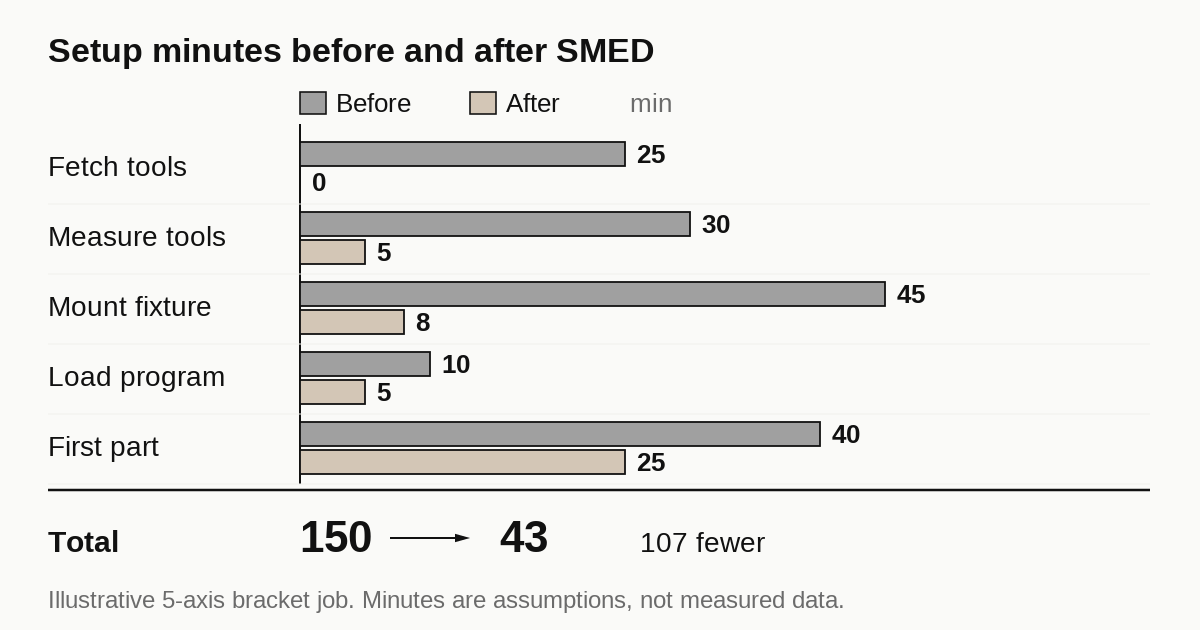
Here is the type of table to build from your own timing. The minutes are assumed for an illustrative 5-axis bracket job.
| Setup step | Before (internal min) | After (internal min) | What changed |
|---|---|---|---|
| Fetch tools and drawing | 25 | 0 | Kitted at the machine during the last job |
| Measure tool lengths | 30 | 5 | Preset offline, offsets loaded from the sheet |
| Mount and align fixture | 45 | 8 | Zero-point plate, pull studs already on the blank |
| Load program, check offsets | 10 | 5 | Program proved on the simulator first |
| First-part prove-out | 40 | 25 | Standard sheet, one probing check per feature group |
| Total internal | 150 | 43 | Machine stopped for 107 fewer minutes |
None of this is measured data. Time your own job before and after, and report the difference in minutes of machine stop, not in a percentage.
Standardising the setup sheet
One sheet per job, kept with the program and updated after every run. Copy this template.
| Field | Entry |
|---|---|
| Part number and revision | |
| Material, grade and heat number of bar | |
| Machine and program name | |
| Fixture, plate and stud positions | |
| Tool list: tool, holder, length, diameter, life limit | |
| Work offset and how it was set | |
| Features probed at first part and the limits | |
| Coolant pressure and nozzle settings | |
| Changes made at prove-out | |
| Setup start and end time, internal minutes |
The last row feeds the next round: SMED asks you to repeat the process. After each lot, read the internal minutes, pick the largest step and move it outside or shorten it.
Talk to us
If your shop runs 5-axis machines on titanium and wants to see how shop registration works, talk to us. We send work requests for titanium parts to partner shops that cut the grade in question: the shop quotes us and we place the PO. There is no fee to join and no charge per request.
Sources
- Wikipedia, Single-minute exchange of die (Shingo, internal and external setup, seven steps)
- Lang Technik, zero point clamping system FAQ (maker claim: repeatability 0.005 mm; no setup time figure given)
- Wikipedia, Overall equipment effectiveness (setup as an availability loss)
Frequently asked questions
What is SMED?
Single-minute exchange of die is a lean method for changing a process from one product to the next quickly. It was named by Shigeo Shingo, who developed it from changeover work at Toyota. The single minute means a single-digit number of minutes, not literally one. It works by moving as much setup as possible outside the time the machine is stopped.
What is the difference between internal and external setup?
Internal setup can only be done while the machine is stopped, such as mounting the fixture on the table. External setup can be done while the previous job is still running, such as kitting tools, presetting tool lengths and proving the program on a simulator. The first aim of SMED is to move steps from internal to external.
Do zero-point plates really repeat to 5 microns?
That is a maker claim. One maker, Lang Technik, states that its zero-point system guarantees a repeatability of 0.005 mm, and gives no test conditions on the page. Treat the figure as a catalogue value and check repeatability on your own machine with an indicator or probe before you depend on it.
Is setup reduction worth it on small titanium lots?
Usually more than on large lots, because setup is spread over fewer parts. A general OEE reference counts setup as a loss that reduces availability. Measure setup minutes on your next three small lots; if setup is a large share of machine time, SMED has room to work.
Need a quote for this part?
Send the drawing. We send one itemised quote for the finished parts and reply within 24 business hours.
Get a titanium quote