Home / Specifications / AMS 4965: Ti-6Al-4V Solution Treated and Aged Bar and Forgings
AMS 4965: Ti-6Al-4V Solution Treated and Aged Bar and Forgings
AMS 4965 is the SAE aerospace material specification for Ti-6Al-4V bars, wire, forgings and flash welded rings supplied solution heat treated and aged; it is the heat treated sibling of AMS 4928, and “Ti-6Al-4V bar per AMS 4965” on a drawing means stock that arrives already at STA strength, in sections of 4.000 inches and under.
Key facts
| Item | AMS 4965 |
|---|---|
| Issued by | SAE International, Aerospace Material Specification |
| First issued | September 1966 |
| Newest revision listed by SAE | N, August 2022 (as of October 2026) |
| Revisions seen on drawings | H (2002), J (2007), K (2011), L (2014), M (2018), N (2022) |
| Alloy | Ti-6Al-4V |
| Condition | Solution heat treated and aged (STA) |
| Product forms | Bars, wire, forgings, flash welded rings |
| Size limit, revision N | 4.000 in (101.60 mm) and under in nominal diameter or least distance between parallel sides; stock for forging and flash welded rings any size |
| Annealed sibling | AMS 4928 |
| Plate | AMS 4911, annealed only |
Scope and revision data are from SAE’s listing. The text of the specification, including its property table and test frequencies, is in the purchased document. This page summarises scope and structure and does not reproduce it.
STA against annealed
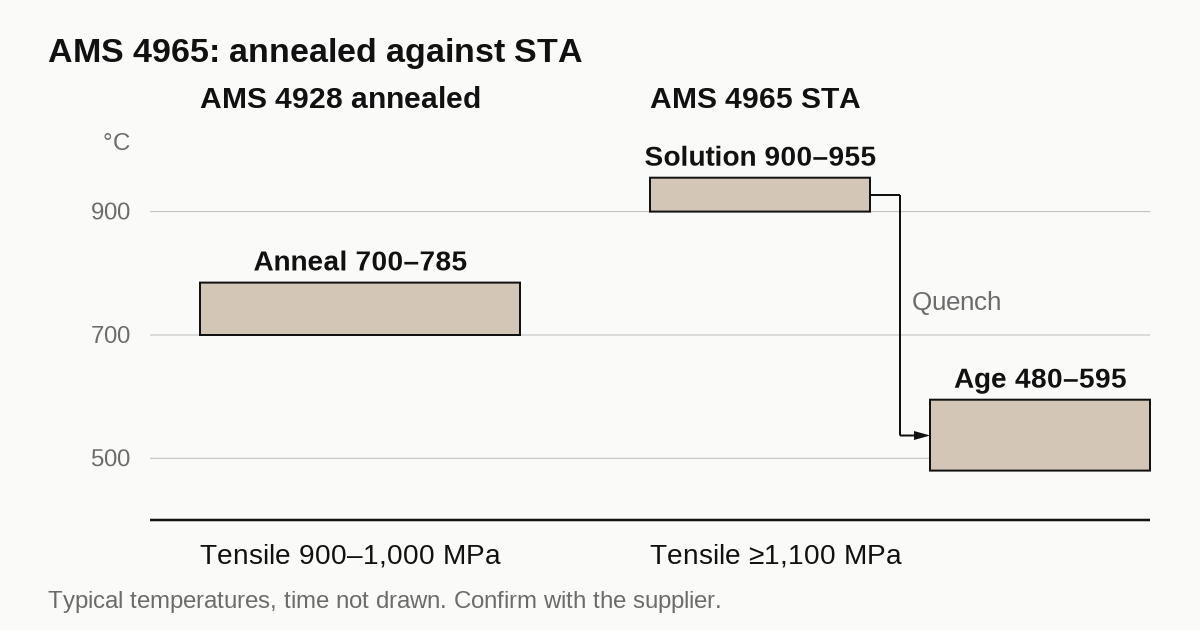
Ti-6Al-4V is usually supplied mill annealed. STA is a second condition reached by heating in the alpha beta range, quenching and ageing. The two are different working conditions with different strength, ductility and cutting behaviour.
| Item | Annealed (AMS 4928) | STA (AMS 4965) |
|---|---|---|
| Heat treatment | Anneal, roughly 700 to 785 C | Solution roughly 900 to 955 C then quench, age roughly 480 to 595 C |
| Typical tensile strength | around 900 to 1,000 MPa | around 1,100 MPa and above |
| Typical hardness | around 32 HRC | around 38 HRC |
| Ductility | Higher | Lower |
| Cutting | The baseline | Typically lower speed, higher tool wear |
| Distortion risk from the quench | None at the shop | Already done at the mill for the bar |
Temperatures, hardness and strength are typical and not promises, and the specification sets the actual cycle and minimums. The solution treated and aged guide explains each step and what STA does to cutting.
What the specification controls
AMS 4965 follows the same structure as the annealed bar specification, with a heat treatment added.
| Area | What AMS 4965 sets, in outline |
|---|---|
| Chemistry | Heat analysis limits for the alloying and residual elements, including hydrogen, oxygen and nitrogen |
| Melting | Permitted melting practice for the ingot |
| Heat treatment | The solution and ageing condition the mill delivers |
| Mechanical properties | Tensile, yield and elongation minimums by size band |
| Microstructure | Criteria for the worked structure |
| Surface | Delivered free of surface contamination such as alpha case |
| Quality | Freedom from defects, with inspection where the specification or order requires it |
| Reports | Certified results and the specification revision on the report |
The hydrogen, oxygen and nitrogen page explains the gas elements every certificate shows, and the tensile test report page explains how the mechanical results are read.
Section size and the 4 inch limit
The 4.000 inch limit in the scope defines which sizes the specification covers. It does not promise that every part of a 4 inch bar reaches full STA strength. Ti-6Al-4V has low hardenability: the quench cools the outside quickly and the centre slowly, and the alloy only strengthens fully where the cooling is fast enough. The STA guide quotes a rule of thumb of around 25 mm for through hardening, and notes that thicker sections reach full strength near the surface and lower strength inside.
Specifications deal with this by size bands, with lower minimums as the section grows. Three consequences follow.
| If the part is | What to do |
|---|---|
| Small in section | Read the minimums in the smallest band |
| Thick, with load at the core | Ask the drawing owner which size band applies and whether the core property is a design requirement |
| Machined from a large bar | The shop may rough machine first, so the finished surface lies closer to the strongest zone. That choice sits in the routing, and the drawing owner approves it if properties are critical |
A report for a thick section that quotes the small-section minimum is a red flag. Ask which band applies.
“STA” on a drawing: three different routes
A drawing that says Ti-6Al-4V STA can mean three different things, and each has its own record.
| Route | What is bought | Governing document | Where the heat treatment record sits |
|---|---|---|---|
| Buy STA bar | Bar certified to AMS 4965 | AMS 4965 | The mill certificate |
| Buy annealed bar, heat treat parts | AMS 4928 bar, then parts treated after machining | AMS 4928 plus AMS 2801 | The shop or its processor |
| Buy annealed bar, specify properties | Bar, then a treatment that meets stated minimums | The drawing, with coupon tests | Coupons and furnace charts |
AMS 2801 covers heat treating titanium alloy parts by a fabricator or its vendors, and SAE lists revision D of March 2024 as the newest. Its scope note says that raw material heat treated by producers, forge shops or foundries falls under AMS-H-81200 instead. The practical rule: AMS 4965 describes the product the mill sells, and AMS 2801 describes what a shop or its processor does to parts. A purchase order that mixes them up gets a certificate that proves the wrong thing.
If the heat treatment is done by an outside processor, the drawing may require a Nadcap accredited processor. The Nadcap page explains what the accreditation covers and how to check it.
The revision letter
SAE issues AMS 4965 with a revision letter. The record runs from the original in 1966 through N in August 2022, and drawings often name an older letter.
| Situation | What to do |
|---|---|
| Drawing names no revision | The mill certifies to the current one. Ask your customer if that is acceptable |
| Drawing names M or older | Buy to that letter, or get written approval to use N |
| Certificate shows a newer letter than the drawing | Hold the lot until the drawing owner approves in writing |
| Drawing says “or AMS 4928 plus AMS 2801” | Confirm which route the customer has approved |
The drawing owner decides whether a newer letter is acceptable. The shop never swaps a revision on its own.
Source approval and the certificate
Many aerospace customers add approved mills, approved stockists and flow down clauses above AMS 4965. Conformance to the specification alone does not satisfy an approved source requirement. The approved mill sources page explains how those lists work.
A certificate against AMS 4965 should show:
- The specification number and revision.
- The heat number, matching the bar marking.
- Chemistry results, including hydrogen, oxygen and nitrogen.
- The heat treatment cycle or its record reference.
- Tensile results with the size band and test direction.
- Microstructure and any inspection results the order requires, then the mill and the release signature.
The mill certificate guide covers how a shop checks those lines.
Export control
Drawings for aerospace parts can be export controlled even when the material is ordinary. Classification stays with the buyer and the shop, not with this site. The export controls guide explains why the drawing is the controlled item. This is not legal advice: confirm with your export compliance officer.
How to call out AMS 4965
| Callout | Complete? | What the shop will do |
|---|---|---|
| “Ti-6Al-4V STA” | No | Ask which route and which specification |
| “Ti-6Al-4V per AMS 4965” | Partly | Buy to the current revision, which may not be the one your customer approved |
| “Ti-6Al-4V bar per AMS 4965 rev M, 2.5 in diameter” | Yes | Buy certified STA bar to that revision and size |
| “Ti-6Al-4V per AMS 4928 then heat treat per AMS 2801” | Yes | Buy annealed bar, send finished or rough parts to a processor |
| “Ti-6Al-4V per AMS 4965 or AMS 4928” | Ambiguous | Ask which condition the part needs |
What to write on the RFQ
- Material line: Ti-6Al-4V per AMS 4965, revision letter, form and size.
- Route: STA bar, or annealed bar with heat treatment of parts, and where in the sequence.
- Heat treatment specification: AMS 2801 or the customer’s own, with the revision and any Nadcap requirement.
- Properties: minimums and the section where they apply, if the core matters.
- Certificates: mill certificate with specification and revision, heat treatment record and a certificate of conformity naming the heat.
- Approved sources: any mill or processor list your customer imposes.
We hold no certificates. We quote your drawing with partner shops that buy to AMS specifications; ask us for the shop’s approvals and check them with the issuing body. Send the drawing through the RFQ form and shops reply within 24 business hours. Other numbers are on the specification index.
Frequently asked questions
What does AMS 4965 cover?
AMS 4965 is the SAE Aerospace Material Specification for Ti-6Al-4V solution heat treated and aged, in the form of bars, wire, forgings and flash welded rings. Revision N covers sizes 4.000 inches (101.60 mm) and under in nominal diameter or least distance between parallel sides, plus stock of any size for forging and flash welded rings.
What is the current revision of AMS 4965?
SAE lists revision N, dated August 2022, as the newest as of October 2026. It replaced revision M of June 2018. Drawings often name an older letter, and the letter on the purchase order is the one the certificate must meet.
Is AMS 4965 the same as AMS 2801?
No. AMS 4965 is a material specification for bar and forgings that the mill delivers in the solution treated and aged condition. AMS 2801 sets requirements for heat treating titanium alloy parts when a fabricator or its vendor does the work. SAE's scope note says heat treatment of raw material by producers, forge shops or foundries falls under AMS-H-81200 instead.
Does STA give full strength through a 4 inch bar?
Not necessarily. Ti-6Al-4V has low hardenability, so the centre of a thick section cools more slowly and reaches less strength. Specifications handle this with size bands that carry lower minimums for larger sections. Read the table in the revision on your drawing.
Sources
- SAE AMS 4965N (August 2022), Titanium Alloy, Bars, Wire, Forgings, and Rings 6.0Al-4.0V, Solution Heat Treated and Aged: scope, size limit and revision history
- SAE AMS 2801D (March 2024), Heat Treatment of Titanium Alloy Parts: scope and revision history
- SAE AMS 4911T (November 2025), Ti-6Al-4V annealed sheet, strip and plate, for comparison
- SAE AMS 4928W (December 2017), Ti-6Al-4V annealed bars, wire, forgings, rings and drawn shapes, for comparison
Last reviewed November 28, 2026. Figures are typical values from the standards and handbooks named above. The standard on your drawing and the mill certificate for your heat govern.
Need a quote for this part?
Send the drawing with the grade and specification lines. We send one itemised quote for the finished parts and reply within 24 business hours.
Get a titanium quote